
Treatment of Newly Diagnosed Myeloma (excluding t-cell redirection therapy)
Category: Treatment of Newly Diagnosed Myeloma (excluding t-cell redirection therapy)
Efficacy and Safety of Ixazomib-Based Maintenance Therapy After Autologous Hematopoietic Stem Cell Transplantation in Multiple Myeloma Patients: A Retrospective Analysis


Hailong Yuan
Chief Physician
Hematology Center, The First Affiliated Hospital of Xinjiang Medical University
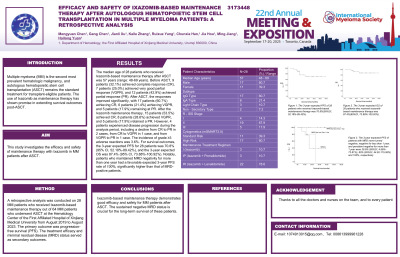
Multiple myeloma (MM) is the second most prevalent hematologic malignancy, and autologous hematopoietic stem cell transplantation (ASCT) remains the standard treatment for transplant-eligible patients. The use of Ixazomib as maintenance therapy has shown promise in extending survival outcomes post-ASCT.This study investigates the efficacy and safety of maintenance therapy with Ixazomib in MM patients after ASCT.
A retrospective analysis was conducted on 28 MM patients who received Ixazomib-based maintenance therapy out of 64 MM patients who underwent ASCT at the Hematology Center of the First Affiliated Hospital of Xinjiang Medical University from August 2019 to August 2023. The primary outcome was progression-free survival (PFS). The treatment efficacy and minimal residual disease (MRD) status served as secondary outcomes.
The median age of 28 patients who received Ixazomib-based maintenance therapy after ASCT was 57 years (range: 48-69 years). Before ASCT, 9 patients (32.1%) achieved complete response (CR), 7 patients (25.0%) achieved very good partial response (VGPR), and 12 patients (42.9%) achieved partial response (PR). After ASCT, the responses improved significantly, with 17 patients (60.7%) achieving CR, 6 patients (21.4%) achieving VGPR, and 5 patients (17.9%) remaining at PR. After the Ixazomib maintenance therapy, 15 patients (53.5%) achieved CR, 8 patients (28.6%) achieved VGPR, and 5 patients (17.9%) retained a PR. However, 4 patients experienced disease progression during the analysis period, including a decline from CR to PR in 2 cases, from CR to VGPR in 1 case, and from VGPR to PR in 1 case. The incidence of grade ≥3 adverse reactions was 3.6%. For survival outcomes, the 3-year expected PFS for 28 patients was 70.8% (95% CI, 52.18%-89.42%), and the 3-year expected OS was 87.4% (95% CI, 73.88%-100.92%). Notably, patients who maintained MRD negativity for more than one year had a favorable expected 3-year PFS rate of 100%, significantly higher than that of MRD-positive patients.
Ixazomib-based maintenance therapy demonstrates good efficacy and safety for MM patients after ASCT. The sustained negative MRD status is crucial for the long-term survival of these patients.