
Myeloma Novel Drug Targets and agents
Category: Myeloma Novel Drug Targets and agents
A Multi-Step Virtual Screening Framework Identifies Novel GPRC5D Inhibitors for Multiple Myeloma Therapy

Xi Chen
MD
Bone Marrow Transplantation Center, the First Affiliated Hospital, Zhejiang University School of Medicine,
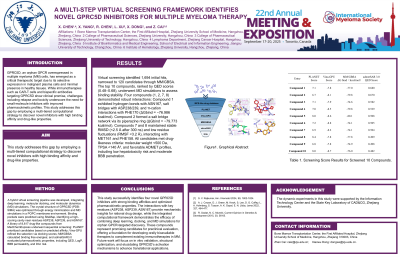
GPRC5D, an orphan GPCR overexpressed in multiple myeloma (MM) cells, has emerged as a critical therapeutic target due to its selective expression in malignant plasma cells and minimal presence in healthy tissues. While immunotherapies such as CAR-T cells and bispecific antibodies targeting GPRC5D show clinical promise, challenges including relapse and toxicity underscore the need for small-molecule inhibitors with improved pharmacokinetic profiles. This study addresses this gap by employing a multi-tiered computational strategy to discover novel inhibitors with high binding affinity and drug-like properties.
Methods:
A hybrid virtual screening pipeline was developed, integrating deep learning, molecular docking, and molecular dynamics (MD) simulations. The crystal structure of GPRC5D (PDB: 9IMA) was optimized through energy minimization and MD simulations in a POPC membrane environment. Binding pockets were predicted using SiteMap, identifying a high-scoring cavity near residues ASP238, ASP239, and ASN167. A library of 8,617 drug-like compounds from MedChemExpress underwent sequential screening: PLANET prioritized candidates based on predicted affinity; Vina-GPU refined the selection via docking scores; MM/GBSA calculated binding free energies; and admetSAR3.0 evaluated pharmacokinetic properties, including QED, LogP, BBB permeability, and DILI risk.
Results:
Virtual screening identified 1,694 initial hits, narrowed to 120 candidates through MM/GBSA. The top 10 compounds, ranked by QED scores (0.48–0.68), underwent MD simulations to assess binding stability. Four compounds (1, 2, 7, 8) demonstrated robust interactions: Compound 1 exhibited hydrogen bonds with ASN167, salt bridges with ASP238/239, and π-cation interactions with PHE170 (ΔGbind = −76.986 kcal/mol). Compound 2 formed a salt bridge network via its piperazine ring (ΔGbind = −79.773 kcal/mol). Compounds 7 and 8 maintained stable RMSD (< 2.5 Å after 300 ns) and low residue fluctuations (RMSF < 3.2 Å), interacting with MET161 and PHE158. All candidates met drug-likeness criteria: molecular weight < 500 Da, TPSA < 140 Ų, and favorable ADMET profiles, including low hepatotoxicity risk and moderate BBB penetration.
Conclusions:
This study successfully identifies four novel GPRC5D inhibitors with strong binding affinities and optimized pharmacokinetic properties. The interactions with key residues (ASP238, ASP239, ASN167) provide mechanistic insights for rational drug design, while the integrated computational framework demonstrates the efficacy of combining deep learning, docking, and MD simulations for orphan GPCR-targeted discovery. These compounds represent promising candidates for preclinical evaluation, offering a foundation for developing orally bioavailable therapies to complement existing immunotherapies in MM. Future work will focus on in vitro validation, structural optimization, and elucidating GPRC5D’s activation mechanisms to advance translational applications.