
Myeloma Genomics and Microenvironment and immune profiling
Category: Myeloma Genomics and Microenvironment and immune profiling
Macrophages promote aberrant DNA repair in multiple myeloma via the CXCL5/CXCR2 axis


Mengmeng Dong (she/her/hers)
Bone Marrow Transplantation Center
The First Affiliated Hospital, Zhejiang University, School of Medicine
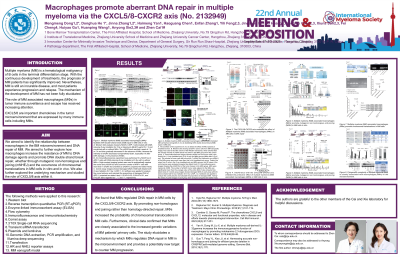
Western blot, RT-qPCR, flow cytometry, immunofluorescence and immunohistochemistry, comet assay, Single-cell RNA sequencing, transient siRNA transfection, Second-generation sequencing, HR and NHEJ reporter assays and MM xenograft model were conducted in the research.
Results:
Our study found that MΦs promoted DNA repair in MM cells by the CXCL5/8-CXCR2 axis both in vitro and in vivo, and protected MM cells progression after DNA damage. However, Other non-tumor cells, like T, NK, neutrophils from peripheral blood and stromal cells in bone marrow, had no such effect of significantly enhancing DNA repair of MM cells. MΦs mainly promoted to the repair of DNA double-strand breaks (DSBs) in MM cells through the non-homologous end joining (NHEJ) pathway both in vitro and in vivo, rather than the homologous repair (HR) pathway to reduce the accuracy of DNA repair. In addition, MΦs increased the probability of chromosomal translocations in MM cells. Furthermore, clinical data confirmed that MΦs are closely associated to the genetic complexity of MM patients' primary cells. MΦs from high cytogenetic risk MM patients had more significant effect of enhancing MM cells DNA repair.
Conclusions:
We demonstrate that cocultured MΦs protected MM cells by promoting DSB repair via CXCL5/8-CXCR2 axis. MΦs enhanced the NHEJ pathway, but reduced repair accuracy and promoted chromosomal translocations in MM cells. The study elucidates a mechanism by which MΦs regulates DNA repair in MM in the microenvironment and provides a potentially new target to counter MM progression.