
Treatment of Newly Diagnosed Myeloma (excluding t-cell redirection therapy)
Category: Treatment of Newly Diagnosed Myeloma (excluding t-cell redirection therapy)
Efficacy and Safety of Daratumumab, Lenalidomide, and Dexamethasone in Transplant-Ineligible Newly Diagnosed Multiple Myeloma Patients: A Single-Center Real-World Study in China
.jpg "Li-juan Fang, MD photo")
Li-juan Fang, MD
Director of Hematology Department of Beijing Jishuitan Hospital
Beijing Jishuitan Hospital, Capital Medical University
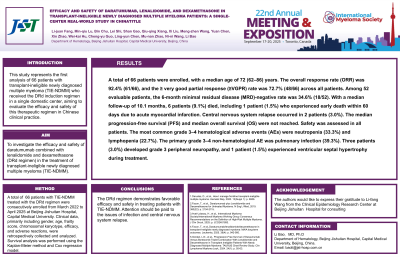
To investigate the efficacy and safety of daratumumab combined with lenalidomide and dexamethasone (DRd regimen) in the treatment of transplant-ineligible newly diagnosed multiple myeloma (TIE-NDMM).
Methods:
A total of 70 patients with TIE-NDMM treated with the DRd regimen were consecutively enrolled from March 2022 to April 2025 at Beijing Jishuitan Hospital, Capital Medical University. Clinical data, primarily including gender, age, frailty score, chromosomal karyotype, efficacy, and adverse reactions, were retrospectively collected and analyzed. Survival analysis was performed using the Kaplan-Meier method and Cox regression model.
Results:
A total of 66 patients were enrolled, with a median age of 72 (62–86) years. The overall response rate (ORR) was 92.4% (61/66), and the ≥ very good partial response (≥VGPR) rate was 72.7% (48/66) across all patients. Among 52 evaluable patients, the 6-month minimal residual disease (MRD)-negative rate was 34.6% (18/52). With a median follow-up of 10.1 months, 6 patients (9.1%) died, including 1 patient (1.5%) who experienced early death within 60 days due to acute myocardial infarction. Central nervous system relapse occurred in 2 patients (3.0%). The median progression-free survival (PFS) and median overall survival (OS) were not reached. Safety was assessed in all patients. The most common grade 3–4 hematological adverse events (AEs) were neutropenia (33.3%) and lymphopenia (22.7%). The primary grade 3–4 non-hematological AE was pulmonary infection (39.3%). Three patients (3.0%) developed grade 3 peripheral neuropathy, and 1 patient (1.5%) experienced ventricular septal hypertrophy during treatment.
Conclusions:
The DRd regimen demonstrates favorable efficacy and safety in treating patients with TIE-NDMM. Attention should be paid to the issues of infection and central nervous system relapse.