
Cellular and T cell engager Immunotherapy
Category: Cellular and T cell engager Immunotherapy
Teclistamab and Talquetamab in Relapse/Refractory Multiple Myeloma (RRMM) Patients with Severe Renal Insufficiency: Case Series

Rebecca Tokarski, PA-C
Physician Assistant
OhioHealth
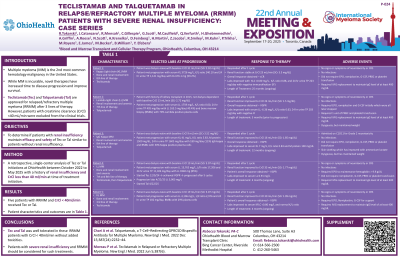
While Multiple Myeloma (MM) is not curable, novel therapies have increased time to disease progression. Teclistamab (Tec) and Talquetamab (Tal), bispecific antibodies, approved for relapsed-refractory Multiple Myeloma (RRMM) but patients with creatinine clearance (CrCl) < 40 mL/min were excluded in the studies. To include these patients in standard therapies, we present five patients with renal insufficiency who responded to Tec and Tal without added toxicity.
Methods: A retrospective, single-center analysis of Tec or Tal initiations at OhioHealth between October 2022 to November 2025 with a history of renal insufficiency and CrCl less than 40 ml/min at time of treatment initiation.
Results:
Patient 1: 67 y/o M with Kappa light chain MM, progressed on 8th line of therapy. CrCl was 31 ml/min. Labs at progression: Serum kappa light chain (KLC) 3726 mg/L, K/L ratio 240.10. Started Tec 6/30/23, at usual prescribed dose. No neurotoxicity (ICANS) or cytokine release syndrome (CRS). Achieved a stringent complete response (CR). Time to first response (TTFR) (≥ Partial Response) 1 month. He had improved CrCl 23 ml/min.
Patient 2: 75 y/o F with Lambda light chain MM progressed on 7th line of therapy. CrCl was 13.44 ml/min. Labs at progression: LLC 1759 mg/l. Started Tal 3/27/24, at usual prescribed dose. No ICANS or CRS. Reported dysgeusia but maintained weight. Achieved a very good partial response (VGPR). TTFR 1 month. She had improved CrCl 24 ml/min.
Patient 3: 80 y/o F with IgG Kappa MM progressed on 8th line of therapy. CrCl was 9.0 ml/min. Labs at progression: KLC 40.62 mg/L, K/L ratio 5.83, M protein 1500 mg/dl. Started on Tal 7/23/24, at usual prescribed dose. Received Dexamethasone for grade 2 ICANS with resolution within 48 hours. Has maintained weight. Skin irritation improved with ammonium lactate. Achieved a partial response (PR). TTFR 1 month. She had improved CrCl 16.2 ml/min.
Patient 4: 77 y/o M with Lambda light chain MM progressed on 5th line of therapy. CrCl was 19 ml/min. Labs at progression: 3.07 mg/dl, LLC 13,765 mg/L, L/K ratio 17,206, Cytoreduced with 3 cycles of VD-PACE, then started on Tec 12/9/24, at usual prescribed dose. No CRS or ICANS. Achieved a VGPR. TTFR 1 month. He had improved CrCl 33 ml/min. Progressed after 5 cycles and started on Tal 4/22/25 with PR after Cycle 1.
Patient 5: 74 y/o M with IgG Kappa MM progressed on 3rd line of therapy. CrCl was 19 ml/min. Labs at progression: KLC 4,106 mg/L, K/L ratio 2,976. Started on Tal 4/7/25 at usual prescribed dose. No CRS or ICANS. Achieved a PR. TTFR 1 month. He had improved CrCl 30 ml/min.
Conclusions: Tec and Tal seem to be well tolerated in RRMM patients with CrCl < 40ml/min without added toxicities. Patients with RRMM with renal insufficiency should not be excluded from getting Bispecifics.