
Myeloma Novel Drug Targets and agents
Category: Myeloma Novel Drug Targets and agents
A new PIKfyve inhibitor shows subnanomolar potency in multiple myeloma

Cecilia Bonolo de Campos, PhD
Scientific Associate
Princess Margaret Cancer Centre
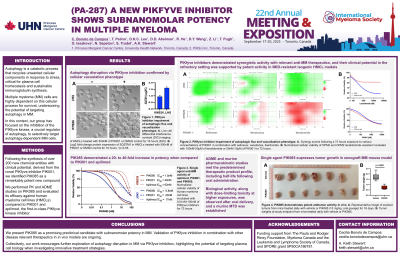
The anti-MM activity of PIKfyve inhibitors was evaluated in the two most sensitive HMCLs, KMS26 and JJN3. Both HMCLs exhibited comparable IC50 values for Apilimod and PIK001 in the low nanomolar range (62 nM and 40 nM for KMS26, and 18 nM and 20 nM for JJN3, respectively). In contrast, our new compound, PIK085, demonstrated a 20- to 40-fold increase in potency, with IC50 values of 1.4 nM in KMS26 and 0.8 nM in JJN3. PIK085 also displayed an improved metabolic stability, with increased plasma concentrations following oral and IV administrations in mice when compared to PIK001 and apilimod.
PIKfyve inhibitors displayed synergistic activity with relevant anti-MM therapeutics, including selinexor, venetoclax, and iberdomide. Clinical potential of PIKfyve inhibition in the refractory setting was also shown by potent activity in IMiD-resistant isogenic HMCL models. Confirmation of autophagy disruption via PIKfyve inhibition was shown by the cellular vacuolation phenotype, a known phenotypic biomarker of PIKfyve inhibition, and increased levels of Sequestosome-1 protein expression.
Conclusions: We present PIK085 as a promising preclinical candidate with subnanomolar potency in MM. Validation of PIKfyve inhibition as a single agent and in combination with other disease relevant therapeutics in in vivo models are n ongoing. Collectively, our work encourages further exploration of autophagy disruption in MM via PIKfyve inhibition, highlighting the potential of targeting plasma cell biology when investigating innovative treatment strategies.