
Treatment of Relapsed/Refractory Myeloma (excluding T-cell redirection therapy)
Category: Treatment of Relapsed/Refractory Myeloma (excluding T-cell redirection therapy)
Differences in treatment goals and expectations among patients with relapsed/refractory multiple myeloma treated in academic vs community settings
Yelak Biru, MSc
Patient Advocate
Patient Advocate
A prospective study (March-June 2024) used 30-minute online surveys of 1301 patients with relapsed/refractory multiple myeloma across 7 countries. Data were analyzed using descriptive statistics and χ2 tests.
Results:
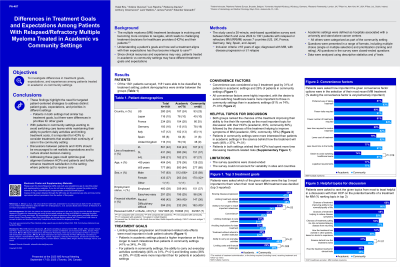
Patient demographics were similar between those treated in academic (n=776) and community (n=405) settings. At the time their most recent treatment was decided, patients ranked their top 3 treatment goals. In both settings, the most common top goals were limiting disease progression (academic: 50%; community: 47%) and managing treatment-related side effects (47%; 48%). The third treatment goal varied between settings.
A further treatment goal for patients in academic settings was to live longer to reach milestones (41% vs 34%; P=.03), whereas those in community settings emphasized being able to perform everyday activities comfortably (40% vs 31%; P<.01) and minimizing treatment-related costs (36% vs 29%; P=.028).
Additionally, convenience, including treatment administration and the timing (including travel, receiving treatment, and follow-up visits), was a top 3 goal for 31% of patients in academic settings and 26% of patients in community settings. All convenience factors were highly important, with avoiding switching healthcare teams more important in community settings than in academic settings (81% vs 74%; P=.019).
Patients said that when discussing new treatments with their healthcare providers, the information they would find most helpful would be the chances of new treatments improving quality of life (63%), relieving symptoms (57%), and achieving remission (55%), with findings similar across settings. However, patients in community settings also prioritized understanding the science behind a treatment (46% vs 37%; P<.01).
Conclusions:
These findings highlight the need for targeted strategies to address distinct patient goals, expectations, and priorities in different settings. Although patients in both settings had similar top treatment goals, other differences existed. Patients in community settings prioritized avoiding switching care teams, maintaining daily activities, and limiting treatment costs. It is thus important that healthcare providers consider treatments that enable continuity of care in the community setting. Addressing these gaps could optimize goal alignment between provider and patient and enhance treatment satisfaction, regardless of the patient’s setting. Limitations included that survey questions were closed-ended and that the survey could not account for variability in sites and countries.