
Treatment of Newly Diagnosed Myeloma (excluding t-cell redirection therapy)
Category: Treatment of Newly Diagnosed Myeloma (excluding t-cell redirection therapy)
Survival of IgA Multiple Myeloma at the National Cancer Institute of Peru

Claudia Castillo, MD
Medical Resident
Instituto Nacional de Enfermedades Neoplasicas / AUNA
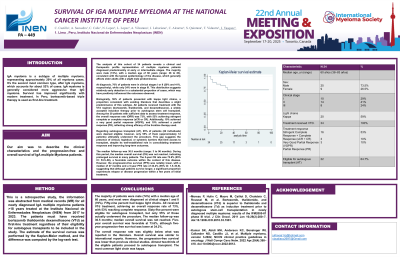
IgA myeloma is a subtype of multiple myeloma, representing approximately 20% of all myeloma cases. It's the second most common type, after IgG myeloma, which accounts for about 52% of cases. IgA myeloma is generally considered more aggressive than IgG myeloma. Survival has improved significantly with modern treatment. In Peru, bortezomib-based triple therapy is used as first-line treatment. Our aim was to describe the clinical characteristics and the progression-free and overall survival of IgA multiple Myeloma patients.
Methods:
This is a retrospective study, the information was abstracted from medical records (MR) for all newly diagnosed IgA multiple myeloma patients >18 years treated at the Instituto Nacional de Enfermedades Neoplasicas (INEN) from 2017 to 2023. The patients must have received bortezomib thalidomide dexamethasone (VTd) as first-line treatment regardless of their eligibility for autologous transplants to be included in the study. The estimate of the survival curves was performed by the Kaplan-Meier method, and the difference was computed by the log-rank test.
Results:
A total of 34 patients were included, mostly were male (74%). The median age was 60 years (range 38-83). The clinical stage was reported as I, II and III in 29 %, 41% and 24% of cases, respectively. 59% had kappa light chains. All patients received VTd. Thirty patients had enough information to evaluate the treatment response: the overall response rate was 73% (stringent complete response + complete response: 53%, very good partial response: 10%: and partial response: 10%). 65% were eligible for autologous transplant (AT), only 55% of this population finally proceed to AT. The median follow-up time was 30.5 months (range 3-96). The median overall survival was not reached. The 5-year overall survival was 73.6% (CI, 53.5-86). The median progression-free survival was 27 months (IQR 12m-NR). The 5-year PFS was 34.2% (CI, 1.5-53.9).
Conclusions:
The overall response rate was slightly below what was reported in the literature. Overall survival was similar to international reports. However, the progression-free survival was lower than previous clinical studies. Almost two-thirds of the eligible patients proceed to autologous transplant. The most common light chain was kappa.