
Myeloma Genomics and Microenvironment and immune profiling
Category: Myeloma Genomics and Microenvironment and immune profiling
Targeting lactate metabolism in multiple myeloma to enhance CAR-T cells antitumor function

Zhaoyun Liu, MD (he/him/his)
vice-professor
Tianjin medical university general hospital hematoloy department
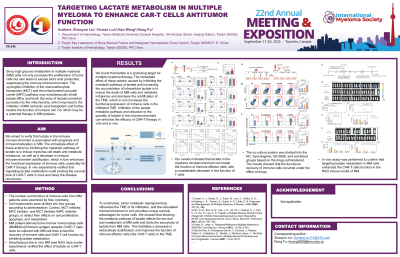
Altering tumor cell metabolism is a promising therapeutic target for multiple myeloma(MM). Increased glucose metabolism in multiple myeloma cells ensures a high proliferation of tumor cells, but also produces excess lactic acid, which suppresses the immune microenvironment.Here,we intend to discovery targeting lactate metabolism in multiple myeloma to enhance immune cell like CAR-T cells antitumor function,which will lead a new therapy methods for both MM cell and CAR-T cell.
Methods:
Altering tumor cell metabolism is a promising therapeutic target for multiple myeloma(MM). Increased glucose metabolism in multiple myeloma cells ensures a high proliferation of tumor cells, but also produces excess lactic acid, which suppresses the immune microenvironment.Here,we intend to discovery targeting lactate metabolism in multiple myeloma to enhance immune cell like CAR-T cells antitumor function,which will lead a new therapy methods for both MM cell and CAR-T cell.
Results:
The results of the analysis indicate the immune suppression in MM patients which may realted to the lactate level in MM patients.By synergistically inhibiting the monocarboxylate transporters (MCT) pathway and the mitochondrial pyruvate carrier (MPC) pathway, which may simultaneously inhibit the lactate efflux and blocking the entry of lactate-converted pyruvate into the mitochondria,it will lead to acidify the intracellular environment of the MM cells and activate oxidative stress of tumor cells. At the same time, with reduce of the extracellular acidification rate, the immunosuppressive microenvironment is alleviated, the effector immune cell(T cell and CAR-T cell) function get be restored and enhanced the anti-tumor effect in vitro and in MM load NSG mice model experiments.
Conclusions:
Our results indicated that targeting lactate metabolic in MM cell can enhance the efficiency of CAR-T cells in MM patients.