
Myeloma Genomics and Microenvironment and immune profiling
Category: Myeloma Genomics and Microenvironment and immune profiling
Dissecting B cell landscape and receptor repertoire in Plasma Cell neoplasms at single cell resolution
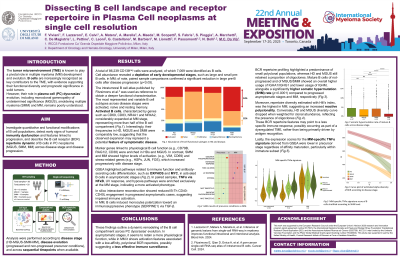
B cells are emerging as key contributors to the tumor microenvironment (TME), with growing evidence supporting their functional diversity and prognostic significance. However, their role in plasma cell (PC) dyscrasias’ evolution, including monoclonal gammopathy of undetermined significance (MGUS), smoldering multiple myeloma (SMM) and MM, remains poorly understood.
In this scenario, our study aims to investigate the functional properties and B cell receptor (BCR) repertoire changes of B cells in the TME of PC neoplasms.
Methods:
Single cell (sc) 5’ RNAseq coupled with scBCRseq was performed on the CD138neg cell fraction of bone marrow (BM) aspirates from 20 patients at diagnosis (7 MGUS and 13 SMM). Paired samples were also obtained from 6 patients at progression to overt MM. A control cohort of 12 healthy donors (HDs) (4 internally sourced, 8 from public repositories) was included. Bioinformatic analysis was conducted using the Seurat pipeline, Gene Set Enrichment Analysis with ClusterProfiler, interactome analysis with Multinichenet, and BCR repertoire profiling applying scRepertoire and Immcantation workflow.
Results:
We analyzed a total of 73,464 CD138neg cells, and a total of 6,890 B cells were annotated according to Fitzsimons et al. B cell atlas. In MM, compared to asymptomatic stages, there was a shift toward an activated B cell phenotype and a decline in naïve B cells. Genes associated with a physiological B cell function (e.g., CD79B, RAG1, CD38) were enriched in HDs and MGUS. In contrast, SMM and MM showed higher levels of activation- (e.g., IFITM1, CD9) and stress-related genes (e.g., HSPs, CD69, JUN, FOS), which increased progressively with disease stage. Pathways related with physiological B cell function, such as OXPHOS, MYC, and mTORC were upregulated in asymptomatic stages while exclusively not-progressed patients were characterized by inflammatory IFN-related pathways. Paired samples analysis revealed that TNFA/NFκB, UV response, and IL2–STAT5 pathways were enriched exclusively at the MM stage, indicating a more activated phenotype.
To gain insight into B cell dysfunction, interactome analysis showed a reduced CD40–CD40L interactions with T helper cells in progressive asymptomatic cases, suggesting impaired activation of immune surveillance. In MM, B cells promoted monocyte immunosuppression (e.g., SERPINE1) via TGF-β.
In progressing asymptomatic cases, we found lower usage of class-switch recombination and somatic hypermutation (p < 0.0001). Finally, BCR diversity, assessed via Hill’s index, was highest in MM, suggesting increased reactive polyclonality.
Conclusions:
These findings reveal dynamic changes in the B cell landscape across PC dyscrasias. In asymptomatic stages, B cells retain more physiological function, while in MM they exhibit increased activation, higher polyclonality, and reduced SHM, suggesting a less specific repertoire. This highlights the evolving phenotype of B cells in disease progression.