
Myeloma Genomics and Microenvironment and immune profiling
Category: Myeloma Genomics and Microenvironment and immune profiling
Defining a Novel Cytokine Combination to Optimize In Vitro Culture Conditions for Primary Multiple Myeloma Patient Cells
Ariene D. Cabantog, BSc (she/her/hers)
PhD Candidate
BC Cancer Research Institute
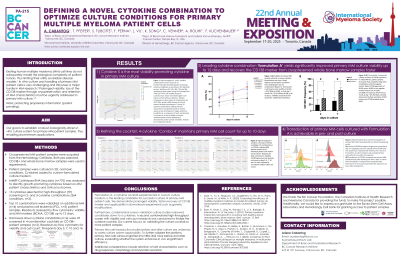
In vitro culture of primary multiple myeloma (MM) patient cells is very challenging and still poses a major hurdle in MM research. Our goal is to establish a robust, biologically-driven in vitro culture system for primary MM patient samples, enabling downstream applications.
Methods: We developed our culture cocktail platform in a systematic, data-driven manner cross-referenced with literature to allow the discovery of novel cytokines. Bioinformatic analyses utilized the MMRF-CoMMpass RNA-Seq dataset of 770 MM patients to investigate cytokine and receptor mRNA expression associated with defined MM patient characteristics and clinical outcomes. Based on the 13 resulting cytokines, a high-throughput combinatorial screen of 2- and 3-cytokine combinations was performed on CD138+ MM patient samples (n=3) over 96 hours. The 10 most viable doublet or triplet cytokine combinations were further validated on more primary CD138+ and whole bone marrow MM patient samples (n=4) as well as plasma cell leukemia (PCL) patient samples (n=3) that were previously engrafted in NRG-3GS mice. Readouts by flow cytometry.
Results:
Validation of the top 10 cytokine combinations on primary MM samples (n=4) and ex vivo patient-derived xenograft (PDX) samples (n=3) revealed a leading cytokine combination that sustained viability and supported the retention of an MM immunophenotype up to 14 days (patent application pending). Final viability between days 10-14 ranged from 65-73%, showing a significant improvement over the initial thaw viability of 50-60%. Our leading cytokine combination achieved a mean viability of 66.7% ± 2.3% SEM, significantly higher than the negative control (medium only) at day 12 (p=0.009, n=4). Another key indicator of successful culture is the recovery of the MM cell marker CD138, which is often lost during freezing and thawing, and its maintenance in culture. Our candidate cocktail supported a faster recovery of CD138 expression in frozen whole bone marrow PCL patient samples (n=3) post-thaw, outperforming other cytokine combinations and the negative control. By day 4 post-thaw, our candidate cocktail yielded a CD138 expression of 39.6% versus 18.8% in the negative control (±4.7% SEM, p=0.048), increasing to 64.9% versus 31.2% by day 7 (±5.2% SEM, p=0.023). To evaluate our cytokine combination in a downstream application, we infected a PCL patient sample with a lentivirus carrying an mCherry fluorescent marker. This approach resulted in a transduction efficiency of 44% with a viability of 65%. Ongoing experiments are to compare lentiviral infection rates in freshly-thawed versus cultured MM cells at multiple timepoints. Preliminary data indicate improved transduction after 5 days in culture (89%) compared to immediate post-thaw (40%).
Conclusions: Our culture system (patent pending) offers broad applications, including drug screening, gene manipulation, and functional studies of primary MM cells, providing a valuable tool for translational research.