
Treatment of Newly Diagnosed Myeloma (excluding t-cell redirection therapy)
Category: Treatment of Newly Diagnosed Myeloma (excluding t-cell redirection therapy)
OPTIMIZATION OF POST-AUTOLOGOUS HEMATOPOIETIC STEM CELL TRANSPLANT (ASCT) MAINTENANCE THERAPY IN MULTIPLE MYELOMA (MM): ANALYSIS OF A SINGLE-CENTER'S RESULTS OVER THE LAST 5 YEARS

María Menor Gómez, MD
Doctor
Hospital Universitario Príncipe de Asturias
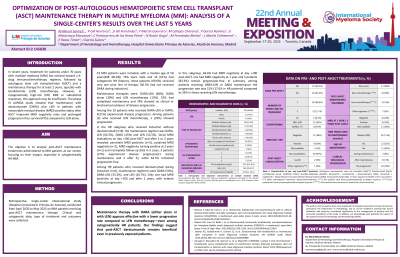
Retrospective, single-center observational study (HU Príncipe de Asturias) conducted from April 2020 to May 2025 on MM patients receiving post-ASCT maintenance therapy. Clinical and cytogenetic data, type of treatment and outcomes were collected.
Results: 23 MM patients were included, with a median age of 58 years(IQR 48–68); 74% were male and 14 (61%) had cytogenetic HR features. Most patients (69.6%) received only one prior line of therapy (56.5% had not received DARA during induction).
Maintenance therapies were: DARA-LEN (48%), DARA alone (30%) and LEN monotherapy (13%). 52% had completed maintenance and 78% showed no clinical or biochemical evidence of disease progression.
Among the 19 patients who received DARA-LEN or DARA, 4(21%) experienced disease progression. Among patients (3) who received LEN monotherapy, 1 (33%) showed progression.
In the HR subgroup who received induction without daratumumab (n=8), the maintenance regimen was DARA-LEN (62.5%), DARA (25%) and LEN (12.5%). Serial MRD evaluations on day +100 post-ASCT and after 1 or 2 years revealed: persistent MRD positivity (n=3), sustained MRD negativity (n=1), MRD negativity turning positive at 2 years (n=1) and incomplete follow-up data in 3 cases. 3 patients (37%) experienced disease progression(1 during maintenance and 2 after it), while 62.5% remained progression-free.
Among HR patients who received daratumumab during induction (n=6), maintenance regimens were DARA (50%), DARA-LEN (33.3%), and LEN (16.7%). Only one had MRD positivity at day +100 and after 2 years, with evident clinical progression. In this subgroup, 66.6% had MRD negativity at day +100 post-ASCT, one had MRD negativity at 1 year and 5 patients (83.3%) remain progression-free.
In summary, among patients receiving DARA-LEN or DARA maintenance the progression rate was 21% (17.6% in HR patients) compared to 33% in those receiving LEN monotherapy.
Conclusions: Maintenance therapy with DARA (either alone or with LEN) appears effective with a lower progression rate compared to LEN monotherapy—even among cytogenetically HR patients. Our findings suggest that post-ASCT daratumumab remains beneficial even in previously exposed patients.