
Cellular and T cell engager Immunotherapy
Category: Cellular and T cell engager Immunotherapy
Abnormal Serum Immunofixation Patterns (ASIP) Are a Common Event Following BCMA CAR-T in Relapsed Refractory Multiple Myeloma and Are Often Preceded by Immunological Events
.jpg "Mateo Mejia Saldarriaga, MD photo")
Mateo Mejia Saldarriaga, MD
Assisstant Professor
Weill Cornell Medicine
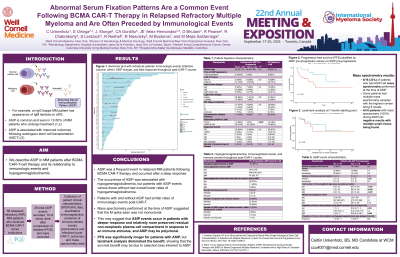
58 p</span>ts were included with 15 receiving idecabtagene autoleucel (26%) and 43 receiving ciltacabtagene autoleucel (74%). ASIP was seen in 18 p</span>ts (31%) during CAR-T follow-up while there was no POD, with 23 total ASIP events. The median time to ASIP was 10 months (range 7 - 18), and median duration was 1.64 months (0.9 - 4.5). 12 of 23 (52%) ASIP events were preceded within 60 days by an immunological event (9 infections (64%), 2 vaccinations (14%), 1 infection and vaccination (7%)). At 21 out of 23 ASIP events (91%), p</span>ts were hypogammaglobulinemic. There was a significantly higher median number of infections in ASIP pts versus non-ASIP pts (2 events (1, 3) versus 4 events (2, 6) p</span> = 0.021), but no significant difference in proportion of pts with infections/vaccinations, or median number of vaccinations. In ASIP versus non-ASIP pts, IgA and IgM were lower than the lower limit of normal (LLN) a significantly higher proportion of the time (IgA low 94% versus 100% (p=0.001), IgM low 69% versus 100% (p = 0.008)), and IgG was higher in ASIP pts. ASIP pts had generally lower rates of hypogammaglobulinemia. 6 pts (33%) had mass spectrometry (MS) performed at the time of ASIP, and all resulted with multiple small clones suggestive of oligoclonal pattern. All 18 ASIP pts (100%) achieved ≥ VGPR, while 29 of 40 (74%) non-ASIP pts achieved ≥ VGPR (p = 0.022), indicating deep response. The median PFS for ASIP pts was not reached (NR, 95% CI 32.2 - NR) and non-ASIP pts was 18.4 months (95% CI 13.0 - NR months) (p = 0.041). Landmark analyses were conducted at 7 months after CAR-T (25th percentile of time to ASIP) and 5 months, with no difference in PFS between groups.
Conclusions: ASIP is a common phenomenon following BCMA CAR-T and was associated with hypogammaglobulinemia at the time of the ASIP episode, but overall ASIP pts had lower rates of hypogammaglobulinemia throughout their post-CAR-T course compared to non-ASIP pts. Infection or vaccination often preceded ASIP, suggesting ASIP may occur in p</span>ts with a relatively more preserved non-neoplastic plasma cell compartment in response to immunologic stimuli; MS results showing multiple clones provides further support. ASIP is significantly associated with deeper response, however landmark analysis accounting for selection bias shows that ASIP does not portend better PFS.