
Cellular and T cell engager Immunotherapy
Category: Cellular and T cell engager Immunotherapy
Consolidative Use of BCMA CAR-T Therapy in Relapsed/Refractory Myeloma — A Retrospective Evaluation


Luca Paruzzo, MD
Post-Doctoral Fellow
University of Pennsylvania
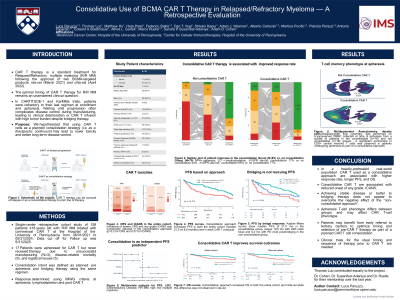
Among 158 treated patients (median follow-up 22.6 months), 83 received CAR-T as consolidation. Median prior lines in these pts was 6, with 76% triple-class refractory, 16% with prior BCMA therapy. Carfilzomib-based triplets were the most common pre-/post-apheresis therapy. At time of apheresis, 10% had PD, 39% SD, 35% PR, and 16% ≥VGPR. 53% received cilta-cel and 47% ide-cel. Post-CAR-T infusion, 83% achieved ≥VGPR (88% for cilta-cel and 77% ide-cel). Median PFS was not reached for cilta-cel (18-month PFS: 83%) and was 16.5 months for ide-cel. OS at 18 months was 89% in cilta-cel and 82% in ide-cel pts. Grade ≥3 CRS was 3.6%, any grade ICANS 8.4%, and delayed neurotoxicity 6%. We then compared these pts to those who did not receive CAR-T as a consolidative approach (no-consolidation group, 75 pts). Clinical characteristics were comparable between groups. As expected, the no-consolidation group had poorer disease control at both apheresis and pre-lymphodepletion, and greater disease burden at apheresis. After CAR-T treatment, consolidation group pts had higher: ≥VGPR rates (83% vs 66%, p=0.02), PFS (not reached vs 8 months. p< 0.01), and OS (cilta-cel subgroup only: OS 18 months 88% vs 70%, p=0.02), and lower ICANS (8% vs 19%) and CRS≥G3 (3.6% vs 8%). No differences in delayed neurotoxicity were seen. In multivariate Cox regression, extramedullary disease, high-risk cytogenetics, ide-cel, and absence of consolidation intent were associated with inferior PFS. Pts in the no-consolidation group who responded to bridging still had inferior PFS compared to the consolidation group.
Conclusions: Late-line RRMM pts moving to CAR-T cells as consolidation of their current line demonstrated higher CAR-T response rates, longer PFS and OS, and reduced severe toxicity, supporting the use of CAR-T as a consolidation strategy in RRMM. These findings should be confirmed prospectively. Comparative analyses of apheresis T-cell phenotypes will be presented at the meeting.