
Cellular and T cell engager Immunotherapy
Category: Cellular and T cell engager Immunotherapy
Outcomes of patients with multiple myeloma post-BCMA directed treatment: an Australian perspective
Jessica Ling, MBBS (Hons)
Haematology Advanced Trainee
Sir Charles Gairdner Hospital
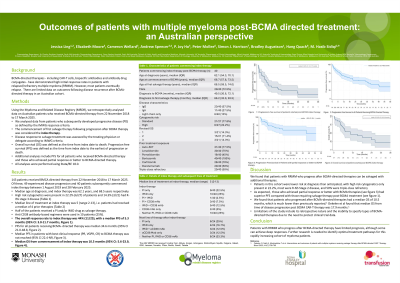
Using the Myeloma and Related Disease Registry (MRDR), we retrospectively analysed Australian patients who received BCMA-directed therapy up to 17 March 2025 and subsequently developed progressive disease (PD) as defined by the IMWG response criteria. The commencement of first salvage therapy following progression after BCMA therapy was considered the index date. Overall survival (OS) was defined as the time from index date to death, and progression free survival (PFS) as the time from index date to the earliest of progression or death. Disease responses to salvage treatments were assessed by the treating physician or delegate according to IMWG criteria. All analyses were performed using Stata/BE 18.0.
Results:
We identified 40 patients who commenced first salvage therapy following progression after BCMA-directed therapy. Of these, 29 (73%) were male. Median age at diagnosis, and index therapy was 62.1 years, and 68.5 years respectively. High risk cytogenetics were present in 22.2% (6/27) of patients and 14.3% (3/21) had R-ISS stage 3 disease. All patients were triple-class refractory and 32.5% (13/40) were penta-drug refractory. Median line of treatment at index therapy was 5 (range 2-13). The median OS from commencement of post-BCMA salvage therapy was 10.5 months (95% CI: 5.6-23.9). Half of the patients received a proteasome inhibitor and/or immunomodulatory drug as salvage therapy. Anti CD38 antibody-based regimens were used in 10 patients (25%). Among the 25 patients with response data available, the overall response rate to first salvage regimen was 44% (11/25), with a median PFS of 5.3 months (95% CI: 3.0-11.7 months)
Conclusions:
Patients with RRMM who progress after BCMA-directed therapy have limited prognosis, although some can achieve deep responses. Further research is needed to identify optimal treatment pathways for this rapidly increasing cohort of myeloma patients.