
Myeloma Genomics and Microenvironment and immune profiling
Category: Myeloma Genomics and Microenvironment and immune profiling
Insights into Ubiquitination-Associated Genes in Multiple Myeloma: A Multi-Omics Mendelian Randomization Study

Jinuo Wang, The First Affiliated Hospital, Zhejiang University School of Medicine (she/her/hers)
physician
The First Affiliated Hospital, Zhejiang University School of Medicine
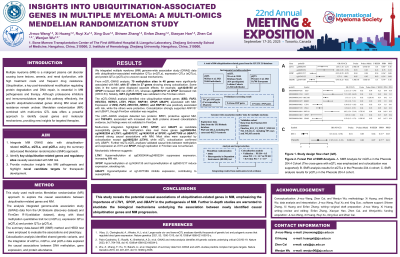
This study integrated MM GWAS with ubiquitination-associated blood mQTLs, eQTLs, and pQTLs to identify causal genetic-epigenetic interactions. SMR analysis revealed 70 MM-associated methylation sites (48 genes), including SPOP with opposing effects: cg14245135 increased risk (OR=1.37) and cg05551217 decreased it (OR=0.53). Nine ubiquitination-related genes (e.g., EED, SPOP, UBAP1) showed divergent MM associations via eQTLs, while pQTLs implicated STC1 (protective) and TNFAIP3 (risk). Multi-omics integration highlighted LTN1, SPOP, and UBAP1, where methylation (e.g., SPOP’s cg14245135/cg05551217) bidirectionally regulated gene expression and MM risk. Hypermethylation at LTN1 sites suppressed expression, elevating risk, whereas UBAP1 hypomethylation reduced expression, increasing susceptibility. Colocalization supported most methylation effects (except LTN1’s cg24692254) and UBAP1 expression, though FinnGen validation failed for eQTL/pQTL findings. Epigenetic modulation of ubiquitination-related genes—particularly SPOP’s dual methylation effects—underscores complex gene-environment interactions in MM pathogenesis.
Conclusions: Our findings highlight the potential causal roles of ubiquitination-related genes, particularly LTN1, SPOP, and UBAP1, in MM pathogenesis. Future study should focus on validating these genes to develop targeted therapeutic strategies.