
Myeloma Genomics and Microenvironment and immune profiling
Category: Myeloma Genomics and Microenvironment and immune profiling
Role and Mechanism of Multiple Myeloma Cells in Regulating Macrophage Polarization and the Antitumor Effect via ENO1

Zhaoyun Liu, MD (he/him/his)
vice-professor
Tianjin medical university general hospital hematoloy department
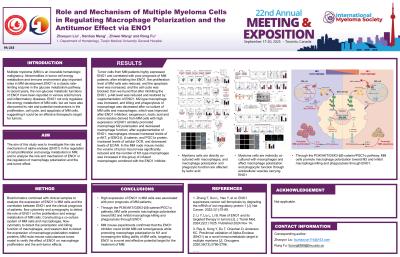
Multiple myeloma (MM) is an incurable hematologic malignancy. Abnormalities in tumor cell energy metabolism and immune environment play important roles in MM development. The aim of this study was to investigate the role and mechanism of alpha-enolase (ENO1) in the regulation of cell proliferation and energy metabolism in MM, and to analyze the role and mechanism of ENO1 in the regulation of macrophage polarization and the anti-tumor effect.
Methods:
Bioinformatics combined with clinical samples to analyze the expression of ENO1 in MM cells and the correlation between ENO1 and the clinical prognosis of patients, flow cytometry and zymography to detect the role of ENO1 on the proliferation and energy metabolism of MM cells; Constructing a co-culture system of MM cells and macrophages, flow-cytometry to detect the polarization and killing function of macrophages, and western-blot to detect the expression of macrophage polarization-related proteins; MM nude mouse subcutaneous tumor model to verify the effect of ENO1 on macrophage proliferation and the anti-tumor effects.
Results:
Tumor cells from MM patients highly expressed ENO1 and correlated with poor prognosis of MM patients; after inhibiting the ENO1, the proliferation level of MM cells was reduced, and the apoptosis level was increased, and the cell cycle was blocked; then we found that after inhibiting the ENO1, p-Akt level was reduced and restored by supplementation of ENO1. M2-type macrophage was increased, and killing and phagocytosis of macrophage was decreased after co-culture of MM cells and macrophages, which was improved after ENO1 inhibition; exogenous L-lactic acid and microvesicles derived from MM cells with high expression of ENO1 similarly promoted macrophage M2 polarization and decreased macrophage function; after supplementation of ENO1, macrophages showed increased levels of p-AKT, p-GSK3-β, β-catenin, and PGC1α protein, increased levels of cellular OCR, and decreased levels of ECAR. In the MM nude mouse model, the volume of tumor mound was significantly reduced and the number of M1-type macrophages was increased in the group of infused macrophages combined with the ENO1 inhibitor.
Conclusions:
High expression of ENO1 may promote MM cell proliferation through PI3K/AKT pathway, ENO1 inhibitor could inhibit MM cell tumorigenesis while promoting macrophage polarization to M1 and increasing the killing ability of MM cells, targeting ENO1 is a novel and effective potential target for the treatment of MM.