
Myeloma Genomics and Microenvironment and immune profiling
Category: Myeloma Genomics and Microenvironment and immune profiling
Integrative Genetic Profiling of Circulating Tumour DNA And Bone Marrow for Multiple Myeloma Prognostication

P. Joy Ho, MBBS DPhil FRACP FRCPA
Director
Institute of Haematology, Royal Prince Alfred Hospital
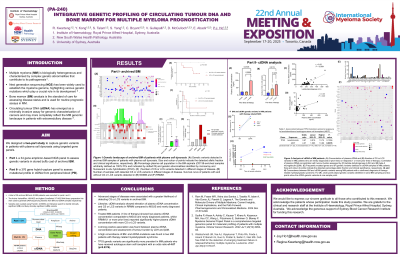
Increased availability of next-generation sequencing (NGS) has expanded our knowledge on the spectrum of genetic alterations in multiple myeloma (MM). Bone marrow (BM) analysis is the standard of care for assessing disease status and is used for routine prognostic assays in MM. Circulating tumour DNA (ctDNA) has emerged as a minimally invasive assay for genomic characterization of cancers and may more completely reflect the MM genomic landscape in patients with extramedullary disease. In this study, we used targeted NGS gene panels to characterize genomic alterations in tumour and ctDNA of MM patients.
Methods:
The two-part study was designed to capture genetic variants in patients with plasma cell dyscrasia. A 34 gene amplicon-based NGS panel was used to assess genetic variants in stored buffy coat of archived bone marrow (BM). A separate 376 gene hybrid-capture panel was used to investigate the mutational profile in ctDNA from patients. Tumour (BM) and ctDNA from each sample were used for library generation using standard protocols, sequenced (Miseq and NextSeq), and analysed using Archer and SeqOne analysis platforms respectively. Variants were curated using Franklin and literature search to identify likely clinically significant (LCS) and clinically significant (CS) variants.
Results:
Thirty-one ctDNA and 22 bone marrow samples were analysed. Advanced stages of disease were associated with greater likelihood of detecting LCS or CS variants in the BM. Panel sequencing of BM identified biallelic TP53 inactivation in a patient, which was not otherwise detected by routine laboratory testing. ctDNA analysis showed a high concordance with BM mutations among patients with secondary myeloid malignancies.
Conclusions:
ctDNA analysis, in a similar pattern to BM analysis, identifies clinically significant variants in patients with plasmas cell dyscrasias, with increased detection of significant variants in advanced disease, and may have utility in the detection of myeloid variants in the evaluation of second malignancy.