
Treatment of Newly Diagnosed Myeloma (excluding t-cell redirection therapy)
Category: Treatment of Newly Diagnosed Myeloma (excluding t-cell redirection therapy)
Survival of Light-Chain Multiple Myeloma at the National Cancer Institute of Peru.

Alexandra Saavedra, MD
Medical Resident
Instituto Nacional de Enfermedades Neoplásicas
Light-chain multiple myeloma (LCMM) is a specific subtype of MM accounting for 15% of all MM cases. In LCMM abnormal plasma cells only produce light-chain proteins (kappa or lambda) instead of both heavy and light chains, leading to unique clinical challenges and manifestations. Data on this specific type of MM was not reported in LATAM. Our aim was to describe the clinical characteristics and the progression-free and overall survival of LCCM patients.
Methods:
This is a retrospective study, the information was abstracted from medical records (MR) for all newly diagnosed light-chain multiple myeloma patients >18 years treated at the Instituto Nacional de Enfermedades Neoplasicas (INEN) from 2017 to 2023. The patients must have received bortezomib thalidomide dexamethasone (VTd) as first-line treatment regardless of their eligibility for autologous transplants to be included in the study. The estimate of the survival curves was performed by the Kaplan-Meier method, and the difference was computed by the log-rank test.
Results:
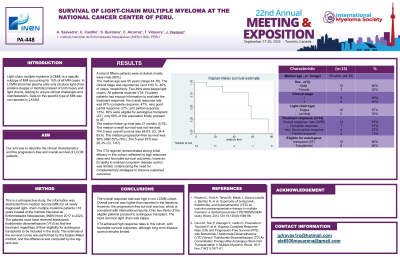
A total of fifteen patients were included, mostly were male (80%). The median age was 55 years (range 44-76). The clinical stage was reported as I and II in 60 % and 40% of cases, respectively. Two-third were kappa light chains. All patients received VTd. Fourteen patients had enough information to evaluate the treatment response: the overall response rate was 87% (complete response: 47%, very good partial response: 27%, and partial response: 13%). 80% were eligible for autologous transplant (AT), only 66% of this population finally proceed to AT. The median follow-up time was 27 months (range 5-76). The median overall survival was not reached. The 5-year overall survival was 64.6% (CI, 34.4-83.6). The median progression-free survival was 58 months (IQR 55m-76m). The 5-year PFS was 26.3% (CI, 1-67).
Conclusions:
The overall response rate was high in our LCMM cohort. Overall survival was higher than reported in the literature. However, the progression-free survival was low, which is consistent with international reports. Only two-thirds of the eligible patients proceed to autologous transplant. The most common light chain was kappa.