
Treatment of Newly Diagnosed Myeloma (excluding t-cell redirection therapy)
Category: Treatment of Newly Diagnosed Myeloma (excluding t-cell redirection therapy)
Daratumumab(Dara) Lenalidomide(R) maintenance following Dara-Carfilzomib(K)R Dexamethasone with tandem transplant in high-risk newly diagnosed myeloma patients: update of the phase 2 study IFM 2018-04

Bénédicte Piron, MD (she/her/hers)
Resident
Department of Hematology, University Hospital of Nantes, France
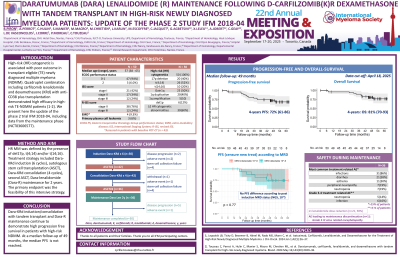
Fifty patients with previously untreated NDMM were included from july 2019 to march 2021 in 11 IFM centers. Median age was 57 (range 38-65). Based on inclusion criteria, all patients had HR cytogenetic, including 17p deletion (n=20, 40%), t(4;14) (n=26, 52%) or t(14;16) (n=10, 20%). Four (8%) patients had extramedullary disease. Efficacy and safety profile of induction, transplant and consolidation were previously reported (Touzeau et al. Blood 2024). With a median follow-up of 49 months, twenty patients (40%) discontinued treatment, due to stem-cell collection failure (n=8), disease progression (n=7), adverse event (n=4), consent withdrawal (n=1). Among the 36 patients who entered the maintenance phase, 6 patients discontinued treatment (disease progression, n=5 ; grade 5 adverse event, n=1). Most common treatment related adverse events ( >15% of patients) during Dara-R maintenance were infections (86%), diarrhea (58%), asthenia (30%), peripheral neuropathy (19%) and neutropenia (19%). Grade 3-4 Dara-R maintenance related adverse events ( >5% of patients) were neutropenia (14%) and infections (16%). One patient discontinued maintenance due to severe adverse event (grade 5 JC virus related encephalopathy). At data cut-off, the 4-year progression free survival was 72% (61-86) and the 4-year overall survival was 81% (70-93). Among the 5 patients with disease progression during maintenance, 4 had negative pre-maintenance Minimal Residual Disease (MRD) (NGS, 10-6), suggesting that MRD negativity might not prevent early relapse at the individual level for patients with HR disease.
Conclusions:
Dara-KRd induction/consolidation with tandem transplant and Dara-R maintenance continue to demonstrate high progression free survival in patients with high-risk NDMM.