
Plasma Cell precursor and Other Disorders
Category: Plasma Cell precursor and Other Disorders
Clinical outcomes of patients with MGUS and diabetes/obesity on GLP-1 receptor agonists: a real-world, propensity-matched study


Ioannis Ntanasis-Stathopoulos, MD (he/him/his)
Clinical and research fellow
Department of Clinical Therapeutics, National and Kapodistrian University of Athens, School of Medicine, Athens, Greece
Monoclonal gammopathy of undetermined significance (MGUS) is a premalignant plasma cell disorder with a risk of progression to multiple myeloma (MM). Emerging evidence suggests that metabolic comorbidities, such as diabetes mellitus (DM) and obesity, may influence clonal evolution and immune microenvironment dynamics. In this context, Glucagon-like peptide-1 receptor agonists (GLP-1 RAs), have demonstrated anti-inflammatory and potential anti-neoplastic properties.
The association between GLP-1 RAs and clinical outcomes (progression to symptomatic MM, death) in patients with MGUS and concurrent DM/obesity was assessed using real-world data from the TriNetX global health research network.
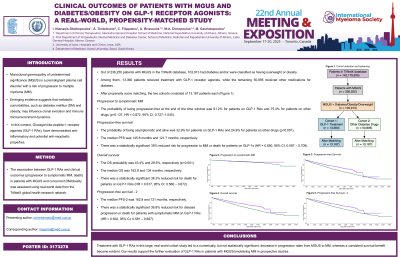
Out of 236,250 patients with MGUS in the TriNetX database, 103,913 had diabetes and/or were classified as having overweight or obesity. Among them, 13,360 patients received treatment with GLP-1 receptor agonists, while the remaining 90,553 did not receive GLP-1 RAs. After propensity score matching, the two cohorts consisted of 13,187 patients each.
The probability of not progressing to MM at the end of the time window was 91.2% for patients on GLP-1 RAs and 75.4% for patients on other drugs (p=0.137). A non-significant trend of 12.8% reduced risk for progression was observed among patients on GLP-1 RAs (HR = 0.872, 95% CI: 0.727 – 1.045) compared to other drugs.
The probability of being asymptomatic and alive was 32.9% for patients on GLP-1 RAs and 24.9% for patients on other drugs (p< 0.001). The median progression-free survival (PFS) was 145.8 months and 121.7 months, respectively. There was a statistically significant 35% reduced risk for progression to MM or death for patients on GLP-1s (HR = 0.650, 95% CI: 0.597 – 0.709), compared to those on other anti-diabetic drugs.
The overall survival (OS) probability was 43.4% and 29.5%, respectively (p< 0.001). The median OS was 162.8 and 134 months, respectively. There was a statistically significant 38.3% reduced risk for progression to symptomatic MM or death for patients on GLP-1 RAs (HR = 0.617, 95% CI: 0.566 – 0.672), compared to those on other anti-diabetic drugs.
It was estimated that among patients who progressed to symptomatic MM, 41% were progression-free and alive at the end of the time window among those on GLP-1 RAs and 26.3% among those on other drugs (p< 0.001). The median PFS-2 was 162.8 and 131 months, respectively. There was a statistically significant 36.8% reduced risk for disease progression or death for patients with symptomatic MM on GLP-1 RAs (HR = 0.632, 95% CI: 0.581 – 0.687), compared to those on other anti-diabetic drugs.
Treatment with GLP-1 RAs in this large, real-world cohort study led to a numerically, but not statistically significant, decrease in progression rates from MGUS to MM, whereas a consistent survival benefit became evident. Our results support the further evaluation of GLP-1 RAs in patients with MGUS/smoldering MM in prospective studies.