
Myeloma Novel Drug Targets and agents
Category: Myeloma Novel Drug Targets and agents
RNF5-DNAJA1 Axis Dictates Selinexor Sensitivity of Multiple Myeloma

xu yinyin, Yes
Mutiple myeloma
Chongqing medical university
Selinexor is the only clinically validated and FDA approved Exportin 1 (XPO1) inhibitor.Despite these limited reported mechanisms of selinexor resistance of MM, the underlying mechanisms remain largely unknown. In this research, we performed proteomic assay on selinexor-treated MM cells to explore the re-distribution of proteins in nucleus and cytoplasm and identify key regulators for selinexor sensitivity. We found a new XPO1-RNF5-DNAJA1 complex in regulating mitochondrial function through activating the UPRmt pathophysiological processes. We also assessed the efficiency of targeting RNF5 and DNAJA1 in augmenting sensitivity of MM to selinexor treatment through in vitro and in vivo experiments.
Methods:
we treated LP-1 cells using selinexor and further performed proteomic assay to compare the protein distribution in the nucleus and cytoplasm against vehicle control cells.We suppressed RNF5 expression using shRNA and ectopically overexpressed RNF5 in LP-1 and MM.1S cells, respectively. Establish the xenograft model and bone-lesion model in the NSG mice to evaluate the in vivo anti-tumor effects of Selinexor. Next, we performed bulk RNA-sequencing assay to identify downstream target genes of RNF5-DNAJA1 axis. To elucidate the practical potential of our findings, we evaluated the efficacy of the combination of targeting RNF5-DNAJA1 axis with selinexor both in vitro and in vivo.
Results:
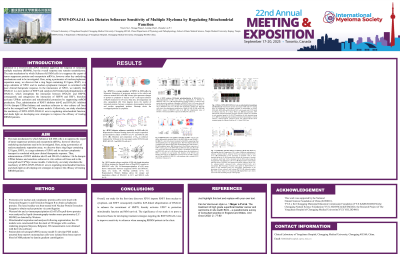
We report a novel mechanism by which XPO1 regulates the translocation of RNF5 from the nucleus to the cytoplasm. In our proteomic analysis, we found that RNF5 was a downstream cargo in the nucleus-cytoplasm translocation process mediated by XPO1. RNF5 induces the K29-linked polyubiquitination of DNAJA1 to control the interaction between DNAJA1 and HSP70, leading to the release of HSF1 into nucleus and activation of UPRmt, thus the re-distribution of RNF5 in the cytoplasm results in improved sensitivity of MM cells to selinexor. Mitochondria in RNF5-DNAJA1 axis disturbed MM cells showed a more swollen morphology, lower levels of OCR, ATP production and UPRmt, proved the protective role of RNF5-DNAJA1 axis in mitochondrial morphology.
Conclusions:
Our study for the first time discovers XPO1 imports RNF5 from nuclear to cytoplasm, and RNF5 consequently modifies K29-linked ubiquitination of DNAJA1 to enhance the recruitment of HSP70.Our study also found that RNF5 induces the K29-linked polyubiquitination of DNAJA1 to control the interaction between DNAJA1 and HSP70, leading to the release of HSF1 into nucleus and activation of UPRmt, thus the re-distribution of RNF5 in the cytoplasm results in improved sensitivity of MM cells to selinexor. The significance of our study is to prove a theoretical basis for developing treatment strategies targeting the RNF5-DNAJA1 axis to improve sensitivity to selinexor when managing RRMM patients in the clinic.