
Myeloma Novel Drug Targets and agents
Category: Myeloma Novel Drug Targets and agents
Targeting of BIRC3 Sensitises Multiple Myeloma Cells to Proteasome Inhibitors
.jpg "Niamh M. McStravick, BSc, MSc photo")
Niamh M. McStravick, BSc, MSc
PhD Student
Queen's University Belfast
Despite significant advances in the treatment of multiple myeloma (MM), including the development of proteasome inhibitors (PIs), this disease is still considered incurable due to inevitable therapy resistance. Thus, it is essential that resistance mechanisms are elucidated, and novel targets are identified to advance treatment and overcome resistance. Network analysis of 20 MM cell lines was carried out using SynLeGG (Synthetic Lethality with Gene Expression and Genomics) to predict genes that could be targeted to increase PI sensitivity. This analysis identified BIRC3 as a potential target gene. BIRC3 codes for an inhibitor of apoptosis protein which is largely involved in regulating both the canonical and non-canonical NF-κB pathways. The aim of this study was to validate BIRC3 as a PI-sensitiser gene and to investigate its potential as a therapeutic target.
Methods:
Five MM cell lines (JJN3, U266, AMO1, OPM2, KMS18) representing diverse cytogenetic subgroups were analysed, along with a PI-resistant model of U266. BIRC3 was silenced using siRNA-mediated knockdown (KD) or chemically inhibited using the bivalent SMAC mimetic BV-6. Combination treatments with BV-6 and PIs were analysed using SynergyFinder to calculate Bliss Synergy scores. Scores < -10 indicate an antagonistic relationship, -10 to 10 indicates an additive relationship, and >10 indicates synergism.
Results:
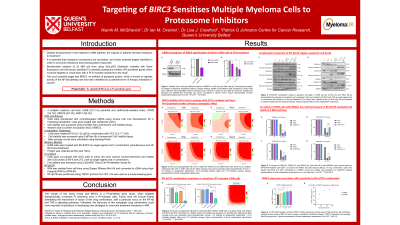
siRNA-mediated KD of BIRC3 significantly reduced viability of MM cell lines compared to control siRNA (p< 0.05) and yielded significant sensitisation to carfilzomib (CFZ) (p< 0.001). Subsequent analysis using BV-6 in combination with PIs (carfilzomib/bortezomib) across five cell lines revealed at least an additive relationship between these drugs (Bliss Synergy score ≥ 5.08). Contrary to previous studies, evidence suggests that sensitivity to this combination is not dependent on TRAF3 mutation status. Pre-treatment with BV-6, to allow for effective BIRC3 degradation, followed by PI treatment further enhanced the synergistic effect (Bliss Synergy score ≥ 12.71). Furthermore, this drug combination is effective in PI-resistant U266 cell lines (Bliss Synergy score ≥ 40.11). Western blot analysis demonstrated cleavage of caspases-3/-8/-9 at 6hrs and 18hrs, suggesting an induction of both intrinsic and extrinsic apoptotic cell death. Preliminary evidence suggests that TNF-α signalling is implicated in mediating sensitivity to this drug combination.
Conclusions:
The results of this study reveal that BIRC3 is a PI-sensitiser gene which, when targeted therapeutically, increases PI sensitivity even in PI-resistant cells. Future work will include further delineating the mechanism of action of this drug combination, with a particular focus on the NF-κB and TNF-α signalling pathways. Ultimately, the discovery of this synergistic drug combination could have important implications in developing new strategies to overcome treatment resistance in MM.