
Myeloma Novel Drug Targets and agents
Category: Myeloma Novel Drug Targets and agents
Autophagy disruption via PIKfyve inhibition strikingly upregulates cholesterol metabolism in multiple myeloma

Daniel K.C Lee, PhD
Postdoctoral Researcher
Princess Margaret Cancer Centre
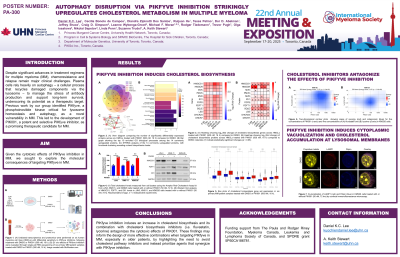
Despite marked advances in available treatment regimens for multiple myeloma (MM), chemoresistance and relapse remain major clinical challenges. In MM, autophagy is critical for plasma cell homeostasis and antibody production, underscoring its potential as a therapeutic target. Previous work by our group identified PIKfyve, a phosphoinositide kinase critical for lysosome homeostasis and autophagy, as a novel vulnerability in MM. Given the cytotoxic effects of PIKfyve inhibition in MM, we sought to explore the molecular consequences of targeting PIKfyve in MM.
Methods:
We performed unbiased transcriptomics and proteomics on six human myeloma cell lines (HMCLs), with a wide range of sensitivities to PIKfyve inhibitors, treated with the novel and potent PIKfyve inhibitor PIK001 (500 nM, 16 hrs) or DMSO control. Ex vivo effects of PIKfyve inhibition was also evaluated through single-cell RNA sequencing on six primary MM patient samples treated with PIK001 (500 nM, 16 hrs) or DMSO control.
Results:
Unbiased transcriptomics and proteomics revealed widespread changes in response to PIKfyve inhibition, with lysosomes and autophagy ranked among the top enriched gene sets in PIK001-treated samples, as expected. Notably, cholesterol biosynthesis was the most significantly enriched gene set in PIK001-treated HMCLs and ex vivo samples. Analysis of upregulated proteins across all cell lines revealed robust induction of key enzymes involved in the mevalonate and cholesterol biosynthesis pathways, including HMGCS1, FDFT1, and IDI1. In line with these findings, a 1.5 to 2-fold increase in total cholesterol levels following PIK001 treatment was confirmed. Synergy studies between PIK001 and cholesterol pathway inhibitors, such as fluvastatin, lycorine, and U18666A, showed strong antagonism, highlighting the importance of cholesterol in mediating the effects of PIK001. Furthermore, preliminary data showed that PIKfyve inhibition induces significant colocalization between LAMP1-positive lysosomes and the cholesterol stain filipin, indicating an accumulation of cholesterol in lysosomal membranes.
Conclusions:
Taken together, PIKfyve inhibition induces an increase in cholesterol biosynthesis and its combination with cholesterol pathway inhibitors antagonizes the cytotoxic effects of PIK001. These findings may inform the design of more effective combinations when targeting PIKfyve in MM.