
MRD and Biomarkers
Category: MRD and Biomarkers
Towards the identification of novel circulating biomarkers associated with bone disease in multiple myeloma


Ioannis Ntanasis-Stathopoulos, MD (he/him/his)
Clinical and research fellow
Department of Clinical Therapeutics, National and Kapodistrian University of Athens, School of Medicine, Athens, Greece
Myeloma bone disease (MBD) remains a debilitating complication of multiple myeloma (MM), yet its early molecular determinants remain incompletely understood. Previously, we identified bone marrow semaphorin 4D (Sema4D), periostin, and activin-A as markers linked to bone resorption and extensive bone disease (BD). In this study, we aimed to examine these markers in plasma to assess their utility for early detection of deregulation of bone microenvironment in patients with smoldering MM (SMM) progressing to MM, with or without clinically evident BD. Furthermore, we sought to identify novel circulating biomarkers associated with MBD through high-throughput plasma proteomics.
We analyzed n=44 newly diagnosed MM patients (median age: 68.1 years; 62.7% female), of whom 35% were ISS-1 and 27.5% ISS-2; 42.5% harbored high-risk cytogenetics. Plasma samples underwent filter-aided sample preparation (FASP) and mass spectrometry-based proteomics to identify BD-associated proteins. In n=24 matched cases, plasma Sema4D, periostin, and activin-A were quantified by ELISA at MM diagnosis and at a preceding SMM timepoint. Multivariate general linear models (GLMs) assessed associations between biomarkers, MBD, and clinical parameters (e.g., ISS, bone lesions). Cox regression was used for survival analyses, and ROC curves assessed diagnostic utility.
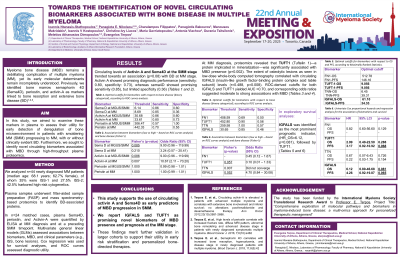
Among established markers, circulating levels of activin A and Sema4D at the SMM stage trended towards an association (p=0.08) with BD at MM stage. Activin A showed promising diagnostic performance (sensitivity: 0.80, specificity: 0.73), whereas sema4D showed promising sensitivity (0.85), but limited specificity (0.36).
At MM diagnosis, proteomics revealed that TUFT1 (Tuftelin 1)—a protein implicated in mineralization—was significantly associated with MBD presence (p=0.002). The extent of osteolytic lesions as seen in low-dose whole-body computed tomography correlated with circulating IGFALS (insulin-like growth factor-binding protein complex acid labile subunit) levels (r=0.488, p=0.008), suggesting a role for IGFALS in osteolytic activity. In exploratory survival analyses, IGFALS was identified as the most prominent prognostic indicator, albeit results were marginally not significant (HR_OS=6.12, p=0.081), followed by TUFT1. ROC-derived cutoffs for both IGFALS and TUFT1 yielded AUC >0.70, and corresponding odds ratios suggested moderate to strong associations with MBD.
This study supports the use of circulating activin A and Sema4D as early predictors of MBD progression in SMM. In addition, we report IGFALS and TUFT1 as promising novel biomarkers of MBD presence and prognosis at the MM stage. These findings merit further validation in larger cohorts to support their utility in early risk stratification and personalized bone-directed therapies.