
MRD and Biomarkers
Category: MRD and Biomarkers
Subclonal and clonal progression of previously characterized mutations and variants of unknown significance (VUS) across a cohort of plasma cell dyscrasia patients

Kristin Ezell, MD
Resident Physician
University of Connecticut
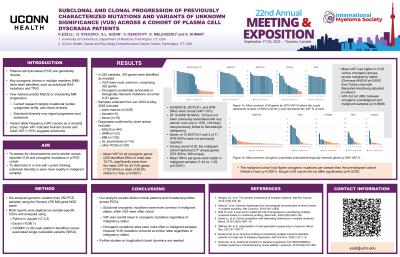
We identified 332 VUS and 81 oncogenic variants in 252 PCD samples. The malignant cohort had higher oncogenic mutations per sample than the premalignant cohort (Welch’s t-test, p< 0.0001), though VUS counts did not differ significantly (p=0.2276). Among VUS, most frequently observed mutations were in KMT2C, ARID1B, NOTCH1, ZFHX3, and ATM. Notably, all ARID1B, NOTCH1, and ATM SNVs were clonal (VAF >10%). Of 19 ARID1B SNVs, 12 have not been previously associated with any cancer; only one (c.1016_1021dup) was previously linked to hematologic malignancy. Seven of 12 NOTCH1 and 3 of 11 ATM SNVs were not previously reported. Among clonal VUS, the malignant cohort harbored 217 unique genes (574 SNVs; 399 unique). Mean SNVs per gene were higher in malignant samples (1.44 vs. 1.09, p< 0.0001). Most frequent oncogenic mutations occurred in DNMT3A, TP53, MYD88, TET2, and CXCR4, with most DNMT3A, MYD88, and CXCR4 variants being subclonal. Mean VAF was higher in VUS versus oncogenic groups across malignancy status (One-way ANOVA p< 0.0001 then Tukey’s test with Benjamini-Hochberg adjusted p-values). VAF did not differ between oncogenic premalignant and malignant samples (p=0.9848).
Conclusions: Our analysis reveals distinct clonal patterns and mutational profiles across PCDs. Subclonal oncogenic mutations were more common in malignant states, while VUS were often clonal. Further studies on longitudinal clonal dynamics are needed.