
Imaging, QoL and Patient-Reported Outcome and Supportive Care
Category: Imaging, QoL and Patient-Reported Outcome and Supportive Care
The HSCT-BIOME Study: double-blinded, randomized, placebo-controlled trial using orally-administered, lyophilized faecal microbiota transplantation to prevent HSCT-associated complications

Angelina Yong, FRACP FRCPA
Haematology Consultant
Royal Adelaide Hospital
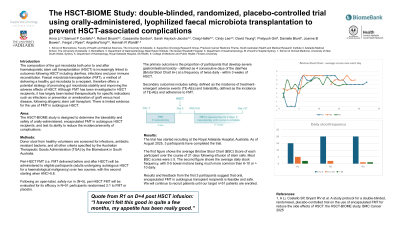
The composition of the gut microbiota both prior to and after haematopoietic stem cell transplantation (HSCT) is increasingly linked to outcomes following HSCT including diarrhea, infections and poor immune reconstitution. Faecal microbiota transplantation (FMT), a method of delivering a healthy gut microbiota to a recipient, therefore offers a potential strategy of promoting gut microbiota stability and improving the adverse effects of HSCT. Although FMT has been investigated in HSCT recipients, it has largely been tested therapeutically for specific indications such as infections or prevention or amelioration of graft versus host disease, following allogenic stem cell transplant. There is limited evidence for the use of FMT in autologous HSCT.
Methods: The HSCT-BIOME study is designed to determine the tolerability and safety of orally-administered, encapsulated FMT in HSCT recipients, and test its ability to reduce the incidence/severity of complications. Peri-HSCT FMT (i.e. FMT delivered before and after HSCT) will be administered to eligible participants (adults undergoing autologous HSCT for a haematological malignancy) over two courses, with the second starting when ANC >0.8. Following an open-label, safety run in (N=5), peri-HSCT FMT will be evaluated for its efficacy in N=51 participants randomised 2:1 to FMT or placebo. The primary outcome is the proportion of participants that develop severe gastrointestinal toxicity - defined as 4 consecutive days of the diarrhea (Bristol Stool Chart 6+) at a frequency of twice daily - within 3 weeks of HSCT. Safety is defined as the incidence of treatment-emergent adverse events (TE-AEs). Tolerability is defined as the incidence of TE-AEs and adherence to FMT.
Results:
The trial has started recruiting at the Royal Adelaide Hospital, Australia. Final results will be available 18 months after completion. Trial registration ACTRN12624001104549.
Conclusions:
The HSCT-BIOME study is a multi-centre, double-blind, randomized placebo-controlled trial designed to determine the tolerability, safety and efficacy of orally-administered encapsulated FMT to promote the stability of the gastrointestinal microenvironment for autologous HSCT recipients, and therefore improving adverse effects of HSCT in recipients. By utilizing a peri-HSCT schedule and avoiding periods of severe immunosuppression (ANC< 0.8), we hope to demonstrate that FMT can be safely administered to autologous HSCT recipients and reduce personal, clinical and economic burden of HSCT complications.