
Imaging, QoL and Patient-Reported Outcome and Supportive Care
Category: Imaging, QoL and Patient-Reported Outcome and Supportive Care
Health-Related Quality of Life in a "real-world" cohort of Chilean patients with Multiple Myeloma.

Rolando Martínez Figueroa, MD
Internal medicine resident
University of Chile, Hospital del Salvador
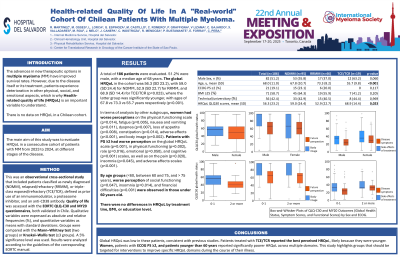
A total of 186 patients were evaluated. 51.2% were male, with an median age of 68 years. The global HRQoL in the cohort was 56.3 (SD 23.2), with 59.0 (SD 24.4) for NDMM, 52.9 (SD 22.7) for RRMM, and 68.9 (SD 14.4) for TCE/TCR (p=0.023), where the latter group was significantly younger, with ages of 67.8 vs 73.3 vs 55.7 years respectively (p< 0.001). In terms of analysis by other subgroups, women had worse perceptions on the physical functioning scale (p=0.014), fatigue (p=0.005), nausea and vomiting (p=0.011), dyspnea (p=0.007), loss of appetite (p=0.008), constipation (p=0.014), adverse effects (p< 0.001), and body image (p=0.002). Patients with PS ≥2 had worse perception on the global HRQoL scale (p=0.001), in physical functioning (p=0.002), role (p=0.016), emotional (p=0.050), and cognitive (p=0.001) scales, as well as on the pain (p=0.020), insomnia (p=0.045), and adverse effects scales (p< 0.001). By age groups (< 60, between 60 and 75, and > 75 years), worse perception of social functioning (p=0.047), insomnia (p=0.014), and financial difficulties (p=0.001) were observed in those under 60 years old. There were no differences in HRQoL by treatment line, BMI, or education level.
Conclusions:
Global HRQoL was low in these patients, similar to other studies. The best perception was reported by TCE/TCR patients, which may be due to them being younger patients. Women, patients with ECOG PS ≥2, and those < 60 years old have significantly worse perception of their HRQoL in several aspects. This study sheds light on which groups should be intervened in certain areas of their HRQoL during the course of their illness.