
Imaging, QoL and Patient-Reported Outcome and Supportive Care
Category: Imaging, QoL and Patient-Reported Outcome and Supportive Care
Assessing the correlation between Canadian multiple myeloma patients’ and caregivers’ perceived quality of life and assessments of validated quality of life instruments

Gabriele Colasurdo, MSc. (he/him/his)
Director
Myeloma Canada
Multiple myeloma (MM) patients experience a higher symptom burden and lower quality of life (QoL) than those with other hematologic cancers. The disease also affects families of patients, with caregivers often receiving little guidance or psychological support. While validated patient- and caregiver-reported outcome (PRO and CRO) questionnaires are widely used to assess the QoL of MM patients and caregivers, they were developed before recent therapeutic advances that have altered the disease course. As a result, these tools may no longer fully reflect MM patient and caregiver experiences.
Methods:
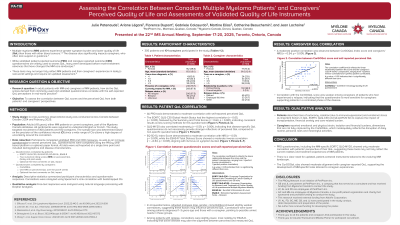
A cross-sectional, observational study was conducted across all Canadian provinces in MM patients and caregivers of MM patients to assess the correlation between QoL scores and individuals’ perception of QoL. Adult participants were identified through Myeloma Canada’s database and data were collected using the PROxy Network web-based platform. All data were self-reported by patients or caregivers and included demographic and disease-related characteristics. Patients completed the EORTC QLQ-C30, EORTC QLQ-MY20, EQ-5D-5L, ESAS-R, and a numeric rating scale (NRS) assessing their perceived QoL. Caregivers completed the CarGOQoL and a NRS reflecting their perceived QoL. Both also provided free-text comments specifying how MM has impacted their QoL. Spearman’s correlation coefficient was used to examine the strength of the association between the global scores from the questionnaires and the participants’ perceived QoL.
Results:
A total of 305 patients (49.8% male; mean age: 65.6 years, Standard Deviation [SD] = 9.0) and 104 caregivers (74.0% female; mean age: 61.6 years, SD = 12.4) participated in the study between October 2024 and February 2025. At the time of the survey, 27.2% of patients and 32.7% of caregivers reported that the patient had experienced a relapse of MM. Correlation analysis revealed a moderate association between patients’ self-perceived QoL and each global score from validated PRO questionnaires, with correlation coefficients (r) ranging from 0.59 to 0.65. Notably, even the MM-specific EORTC QLQ-MY20 demonstrated only a moderate correlation with patients’ perceived QoL, ranking among the lowest (r = 0.59; 95% confidence interval [CI]: 0.51–0.66; p < 0.001). The caregiver-reported QoL, as measured by the CarGOQoL, showed a moderate correlation with caregivers’ self-perceived QoL (r = 0.54; 95% CI: 0.38–0.67; p < 0.001).
Conclusions:
The moderate correlations demonstrate that the content of QoL questionnaires for MM patients and their caregivers needs to be adapted to better reflect the evolving challenges they face. Advances in treatment have brought changes in disease trajectory such as longer survival, evolving side effect profiles, and long-term health issues that are not adequately assessed in current PRO and CRO instruments. Analysis of the comment box section provided insights aligned with the results of the correlation analysis.