
Cellular and T cell engager Immunotherapy
Category: Cellular and T cell engager Immunotherapy
Real-World Treatment Patterns Associated With Elranatamab Among Patients With Relapsed/Refractory Multiple Myeloma: The ALTITUDE-2 Study

Meera Mohan, MD
Assistant Professor
Medical College of Wisconsin
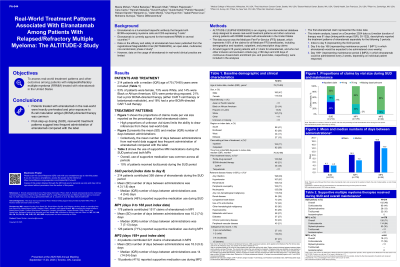
ALTITUDE-2 (EUPAS1000000293) is an ongoing, non-interventional database study designed to assess real-world treatment patterns and other outcomes among United States patients with RRMM treated with ELRA. The data source was the Medicare Fee-For-Service (FFS) dataset (December 2024 data cut), which represents 100% of the claims for all Medicare FFS beneficiaries including demographics and inpatient, outpatient, and prescription drug claims. All adult (≥18 years) patients with at least one claim for ELRA, and who met other inclusion and exclusion criteria (e.g., ≥180 days and ≥30 days of continuous closed-claim enrollment pre- and post-index, respectively), were included in the analyses. The first ELRA claim represented the index date. This interim analysis descriptively reported the treatment patterns of ELRA separately for the step-up dosing period (“SUD period”; Index to Day 8), maintenance period 1 (“MP1”; Day 9 to Day 168, where per label QW is expected), and maintenance period 2 (“MP2”; Day 169+, where per label Q2W is expected, depending on patient response).
Results: N=237 patients treated with ELRA were included (median age=74 years, interquartile range [IQR]=69-79 years; 56% female, 72% White, 15% Black) with a median follow-up time of 4.4 months (IQR = 2.0-8.2 months). The median time from diagnosis to starting ELRA was 67 months (IQR=42-98 months). 62% of patients were penta-drug exposed and 23% had a prior commercial BCMA-directed therapy (CAR T-cell therapy or belantamab, with 19% having a prior CAR T-cell therapy). There were 241 claims of ELRA during MP1 (Days 9-168 post-index). The median number of days between administrations was 7 (Q1 = 7, Q3 = 13 days), with approximately a quarter of administrations already occurring on a Q2W cadence during this period. There were 62 claims of ELRA in MP2 (Days 169+ post-index). The median number of days between administrations was 14 (Q1 = 14, Q3 = 28 days), with approximately 25% of administrations occurring on a monthly (Q4W) cadence.
Conclusions:
Patients treated with ELRA in the real-world were heavily pre-treated, and prior exposure to BCMA-directed therapy was common. During MP1 and MP2, real-world treatment patterns suggest less frequent administration of ELRA compared with the label.