
Nursing and Allied Health Symposium
Category: Nursing & Allied Health Symposium
The power of partnership: supporting patient adherence to treatment through a unique collaboration of healthcare professional and patient organisations

Monica Morris, RN, MSc
Clinical Practice Programme Manager
Myeloma UK
The development of new myeloma treatments in the past 20 years has increased treatment options and the complexity of regimens. Patients commonly receive quadruplet myeloma therapy, in addition to supportive medications. Treatments are largely outpatient-based and healthcare professionals (HCPs) are required to help patients understand complex regimens, including provision of written medication schedules.
To aid and standardise production of treatment schedules, an Australian/New Zealand haematology society developed an online tool (MyeTxScheduler https://rego.interact.technology/myetx/) pre-populated with standard myeloma protocols. The tool allows HCPs to create printed, point-of-care, myeloma treatment schedules that patients use to tick off medications as taken. Treatments can be individualised as clinically indicated. The schedule also includes dates for appointments and links to patient information.
Following successful implementation in Australia and New Zealand, a baseline survey by United Kingdom (UK) nurses and pharmacists revealed variation in practices related to myeloma medicine aids and identified a gap. A proposal was made to adapt MyeTxScheduler for UK use.
Methods:
A working group of UK myeloma pharmacist and nurse groups, Australian HCPs, and a UK patient organisation, partnered to expand the tool to include UK-specific regimens and information. Collaboration with the UK patient organisation, and an Australian patient support group, provided necessary funding to support the work.
Following adaptation, MyeTxScheduler now includes 32 approved myeloma treatment protocols. HCPs from 11 UK hospitals were invited to pilot its use and HCPs and patients were asked to feedback on their experience using the tool.
Results:
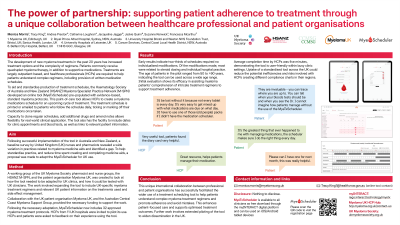
Early results indicate two-thirds of schedules required no modifications. Most modifications were related to steroid dosing, reflecting individual hospital practice. The age of patients in the pilot ranged from 50 to >90 years, indicating the tool can be used across a wide age range. Initial evaluation shows its efficacy in assisting myeloma patients’ comprehension of intricate treatment regimens to support treatment adherence. One patient described the tool as ‘the greatest thing that ever happened to me with managing medications, the scheduler makes sure I do the right thing every day’.
Average completion time by HCPs was five minutes, demonstrating the tool is user-friendly within busy clinic settings. Uptake of a standardised tool across the UK could reduce the potential inefficiencies and risks involved with HCPs creating different compliance charts in their regions.
Conclusions:
This unique international collaboration has successfully facilitated the wider use of a treatment scheduling tool to enhance patient understanding of and adherence to myeloma treatment. This, in turn, supports optimised patient outcomes. Further work involves extended piloting to widen dissemination.