
Nursing and Allied Health Symposium
Category: Nursing & Allied Health Symposium
Evaluating a Hybrid Approach to Oncology Pharmacy: A Comparison of Service Delivery Models for Immunomodulatory Drug Management

Hayley Underhill, Pharmacy Student (she/her/hers)
Pharmacy Student
Horizon Health Network
The value of clinical pharmacists in the management of patients receiving oral anticancer medications has been increasingly recognized in recent years. Pharmacists are uniquely equipped to provide comprehensive care to patients prescribed these agents, which often have specific monitoring requirements and require frequent assessment for adverse effects.
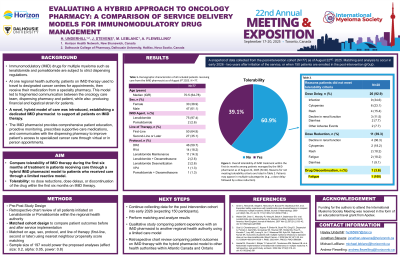
Immunomodulatory (IMiD) drugs such as lenalidomide and pomalidomide are anticancer agents that can be used in the treatment of multiple myeloma (MM) and are subject to strict dispensing regulations. Historically, patients in one regional health authority were required to travel to one of five designated cancer care centres to meet with their oncology team, after which they received their medication from a specialty pharmacy. This model presented significant challenges, including fragmented communication between the dispensing pharmacy and the oncology team, often placing the burden on patients to coordinate care. Additionally, the need for travel imposed additional financial and logistical strain, particularly for those living in rural or underserved areas.
To address these gaps and promote equitable, patient-centred care, a novel hybrid care model was introduced within the health authority. In March 2024, a three-year-pilot program was launched, establishing a dedicated IMiD pharmacist to support all patients on IMiD therapy. The pharmacist provides comprehensive patient education, proactive monitoring, prescribes supportive care medications, and communicates with both the dispensing pharmacy and cancer care team to provide comprehensive, efficient care and improve patient’s access to specialized cancer care through virtual or in-person appointments.
The objective of this study is to evaluate the impact of the hybrid pharmacist monitoring program on patient outcomes, specifically examining the tolerability of IMiD therapy before and after implementation. Findings from this evaluation will inform future decisions by health authorities regarding the continuation or expansion of the hybrid pharmacy service and support the development of additional pharmacist-led clinical care models.