
Imaging, QoL and Patient-Reported Outcome and Supportive Care
Category: Imaging, QoL and Patient-Reported Outcome and Supportive Care
Inadequate Racial reporting among references forming the basis of NCCN guidelines for Multiple Myeloma and Systemic Light Chain Amyloidosis

Craig Emmitt Cole, MD (he/him/his)
Associate Professor
Karmanos Cancer Institute-Wayne State and Michigan State University
Black individuals make up 13.6% of the U.S. population and account for approximately 20% of new multiple myeloma (MM) diagnoses. The incidence of MM in black individuals is twofold higher compared to white individuals however, the incidence and percentage of blacks with systemic light chain amyloidosis (SLCA) has yet to be defined. The National Comprehensive Cancer Network (NCCN) guidelines are widely used to inform the evaluation, diagnosis and treatment of these conditions. Prior analyses of the International Working Group (IMWG) guidelines have shown poor black representation in supporting studies. We conducted a literature review of the racial demographics of the clinical studies referenced in the 2024 NCCN guidelines for MM and SLCA.
Methods:
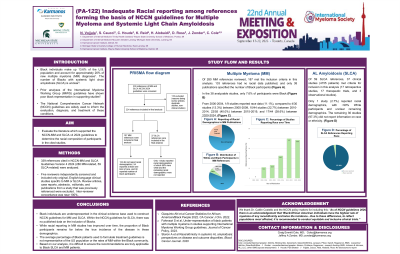
342 references cited in NCCN-MM and SLCA Guidelines Version 4.2024 (283 MM-related, 59 SLCA-related) were analyzed. Five reviewers independently screened and included only original, English-language clinical studies specific to MM or SLCA. Exclusions included review articles, non-clinical studies, commentaries, abstracts, case reports, animal studies, and duplicate data that was previously referenced. Inter-reviewer concordance was near 100%; discrepancies were resolved by consensus, and racial data were analyzed.
Results:
SLCA:
Of 59 SLCA references, 42 clinical studies (4994 patients) met criteria for inclusion in this analysis (20 retrospective studies, 14 therapeutic trials, and 8 prospective observational studies). Only 2 studies (4.8%) reported racial demographics—with ~90% White participants and unclear remaining demographics. The remaining 39 studies (92.9%) did not report information on race or ethnicity.
MM:
Of 283 MM references reviewed, 187 met the inclusion criteria in this analysis. 133 references had no racial data published and only 38 publications specified the number of Black participants. In the 38 analyzable studies, only 7.6% of participants were Black. Racial reporting has increased over time. From 2000-2004, 1/9 studies reported race data (11.1%), compared to 4/30 studies (13.3%) between 2005-2009, 10/44 studies (22.7%) between 2010-2014, 22/55 (40.0%) between 2015-2019, and 17/44 (38.6%) between 2020-2024.
Conclusions: Black individuals are underrepresented in the clinical evidence base used to construct NCCN guidelines for MM and SLCA. Within the NCCN guidelines for SLCA, there was no published data on the inclusion of Blacks. While racial reporting in MM studies has improved over time, the proportion of Black participants remains far below the true incidence of the disease. To improve equity and relevance, we encourage the NCCN to champion the mandatory reporting of racial demographics in cited studies and to promote more representative patient enrollment that aligns with disease prevalence across racial groups.