
Cellular and T cell engager Immunotherapy
Category: Cellular and T cell engager Immunotherapy
Impact of Frailty Tools on Outcomes in Myeloma: MRP and Simplified Index Predict Survival but Differ in Infection Risk Stratification

Weiwei Tian, Chief Physician, MD, PhD Supervisor at Shanxi Medical University
Chief Physician、Chief of Hematology Department
Shanxi Bethune Hospital, Shanxi Academy of Medical Sciences,Tongji Shanxi Hospital, Third Hospital of Shanxi Medical University
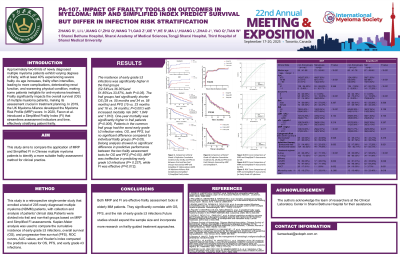
Approximately two-thirds of newly diagnosed multiple myeloma patients exhibit varying degrees of frailty, with at least 40% experiencing severe frailty. As age increases, frailty often intensifies, leading to more complications, deteriorating renal function, and worsening physical condition, making some patients ineligible for anti-myeloma treatment. Frailty significantly impacts the overall survival (OS) of multiple myeloma patients, making its assessment crucial in treatment planning. In 2019, the UK Myeloma Alliance developed the Myeloma Risk Profile (MRP) score. In 2020, Facon et al. introduced a Simplified Frailty Index (FI) that streamlines assessment indicators and time, effectively stratifying patient frailty. This study aims to compare the application of MRP and Simplified FI in Chinese multiple myeloma patients to identify a more suitable frailty assessment method for clinical practice.
This study is a retrospective single-center study that enrolled a total of 205 newly diagnosed multiple myeloma (NDMM) patients, with collection and analysis of patients' clinical data.Patients were divided into frail and non-frail groups based on MRP and Simplified FI assessments. Kaplan-Meier analysis was used to compare the cumulative incidence of early grade ≥3 infections, overall survival (OS), and progression-free survival (PFS). ROC curves, AUC values, and Youden's index compared the predictive values for OS, PFS, and early grade ≥3 infections.
The incidence of early grade ≥3 infections was significantly higher in the frail groups (52.54%vs.36.30%and 51.85%vs.33.87%, both P< 0.05). The frail groups had significantly shorter OS (28 vs. 55 months and 34 vs. 58 months) and PFS (15 vs. 33 months and 16 vs. 34 months; P< 0.001) with increased mortality risk (HR: 1.849 and 1.810). One-year mortality was significantly higher in frail patients (P< 0.005). Patients in the common frail group had the worst early grade ≥3 infection rates, OS, and PFS, but no significant difference compared to individual frailty groups (P>0.05). Delong analysis showed no significant difference in predictive performance between the two frailty assessment tools for OS and PFS (P< 0.05). MRP was ineffective in predicting early grade ≥3 infections (P= 0.237), while FI was effective (P=0.012).
Both MRP and FI are effective frailty assessment tools in elderly MM patients. They significantly correlate with OS, PFS, and the risk of early grade ≥3 infections.Future studies should expand the sample size and incorporate more research on frailty-guided treatment approaches.Corresponding author:Weiwei Tian.