
Myeloma Novel Drug Targets and agents
Category: Myeloma Novel Drug Targets and agents
Belantamab Mafodotin plus Lenalidomide/Dexamethasone in Newly Diagnosed Patients with Multiple Myeloma: Long-Term Efficacy and Safety Results from the Phase 1/2 BelaRd Study

Evangelos Terpos, MD (he/him/his)
Professor
Department of Clinical Therapeutics, National and Kapodistrian University of Athens, School of Medicine, Athens, Greece
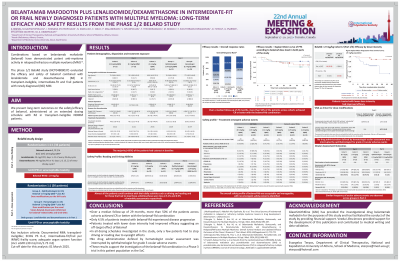
Part 1 (dose finding) of the ongoing phase 1/2 BelaRd trial (NCT04808037) assessed the safety/tolerability of belamaf 2.5/1.9/1.4 mg/kg plus Rd, establishing a recommended phase 2 dose (RP2D) of 1.9 mg/kg Q8W (extendable to Q12W), guided by ophthalmologist-assessed ocular adverse events (OAEs; best corrected visual acuity [BCVA] change from baseline and keratopathy) using the Keratopathy and Visual Acuity scale. In Part 2 (dose extension), the safety/efficacy of belamaf RP2D plus Rd is evaluated in 2 groups: in Group A belamaf dosing is guided by ophthalmologist- assessed OAEs, and in Group B dosing is guided by hematologist-assessed patient-reported, 9-question Vision-Related Anamnestic tool (VRA; capturing ocular symptoms & their impact on activities of daily living [ADL], rated as occurring substantial/minimal/none of the time) and Gr≥3 OAEs. Long-term (cutoff 01/03/2025) safety/efficacy results from Parts 1/2 are presented.
Results:
Of Part 1 pts (n=36; median age: 73 yrs), 25 (69%) are ongoing with treatment, and 11 (31%) discontinued (fatal adverse event [AE]: 8 [22%]; progressive disease [PD]: 1 [3%]; consent withdrawal: 2 [6%]). 17%/75% of pts had stage I/II disease per R-ISS and 8% had high-risk cytogenetics. At a median follow-up of 39 months, the overall response rate (ORR) was 100%. Meaningful BCVA decline (Snellen < 20/50 and ≥3 lines drop in better-seeing eye) was noted in 15% and Gr2/≥3 keratopathy in 11%/3% of ocular exams. Median times to resolution (TTR) of Gr≥2 BCVA/keratopathy were 2/1 months. Most common (≥10%) non-ocular Gr≥3 AEs were fatigue, diarrhea, rash, COVID-19, pneumonia, and insomnia. Of Part 2 pts (n=30; median age: 76 yrs), 22 (73%) are ongoing with treatment and 8 (27%) discontinued (fatal AE: 6 [20%]; PD: 1 [3%]; consent withdrawal: 1 [3%]). 27%/63% of pts had stage I/II disease per R-ISS and 17% had HRC. At a median FU of 23 months, ORR was 97%. Meaningful BCVA decline was noted in 9% and Gr2/≥3 keratopathy in 9%/< 1% of ocular exams. The median TTR of Gr≥2 OAEs was 2 months. Most common (≥10%) non-ocular Gr≥3 AEs were fatigue and rash. Across the ADL-related questions of the VRA, assessments with ‘substantial’ time findings were 2%/6% in Groups A/B. Discordance between Gr≥3 OAE and less than 'substantial time' findings reported with the VRA tool occurred in 10/300 and 2/251 ocular assessments in Groups A/B and in none (0/121) of the Group B dosing cycle assessments. The 12/24/36-month time to progression rates for all 66 pts were 98%/98%/94%.
Conclusions:
Consistent with the DREAMM-7/8, belamaf exhibits notable clinical activity in unfit NDMM, achieving rapid, deep, and durable responses. OAEs resolved quickly, without substantially impacting the ADL. No new safety signals emerged.