
Myeloma Genomics and Microenvironment and immune profiling
Category: Myeloma Genomics and Microenvironment and immune profiling
Dual roles of IRE1α inhibition in reversing mitochondrial ROS-induced CD8+ T cell senescence and exerting direct anti-tumor effects in multiple myeloma

Yike Wan, MD, PhD
Resident doctor
Department of Hematology, Ren Ji Hospital, Shanghai Jiao Tong University School of Medicine
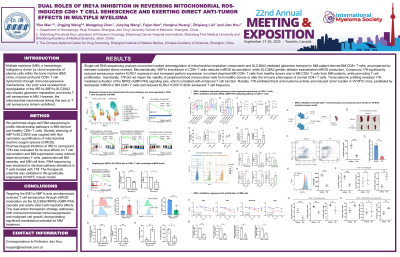
Multiple myeloma (MM), a hematologic malignancy driven by clonal expansion of plasma cells within the bone marrow (BM) niche, induces profound CD8+ T cell dysfunction through immunosuppressive mechanisms. Our prior work revealed that dysregulation of the IRE1α-XBP1s-SLC38A2 axis impairs glutamine metabolism and drives T cell senescence in MM. However, the mitochondrial mechanisms linking this axis to T cell senescence remain undefined.
Methods:
We performed single-cell RNA sequencing to profile mitochondrial pathways in MM-derived and healthy CD8+ T cells. Genetic silencing of XBP1s/SLC38A2 was coupled with flow cytometric quantification of mitochondrial reactive oxygen species (mtROS). Pharmacological inhibition of IRE1α (compound 17#) was evaluated for its dual effects on T cell rejuvenation and MM suppression using nutrient-deprived primary T cells, patient-derived BM samples, and MM cell lines. RNA sequencing was employed to disclose pathway alterations in T cells treated with 17#. The therapeutic potential was validated in the genetically engineered Vk*MYC mouse model.
Results:
Single-cell RNA sequencing analysis uncovered marked downregulation of mitochondrial respiration components and SLC38A2-mediated glutamine transport in MM patient-derived BM CD8+ T cells, accompanied by elevated oxidative stress markers. Mechanistically, XBP1s knockdown in CD8+ T cells reduced mtROS accumulation, while SLC38A2 genetic ablation exacerbated mtROS production. Compound 17# significantly reduced senescence marker KLRG1 expression and increased perforin expression in nutrient-deprived BM CD8+ T cells from healthy donors and in BM CD8+ T cells from MM patients, while promoting T cell proliferation. Importantly, 17# did not impair the viability of peripheral blood mononuclear cells from healthy donors or alter the immune phenotypes of normal CD8+ T cells. Transcriptomic profiling revealed 17#-mediated activation of the NPR2-cGMP-PKG signaling axis, which correlated with enhanced T cell function. Notably, 17# exhibited direct anti-myeloma activity and reduced tumor burden in Vk*MYC mice, paralleled by decreased mtROS in BM CD8+ T cells and reduced KLRG1+CD57+CD28- senescent T cell frequency.
Conclusions:
Targeting the IRE1α-XBP1s axis simultaneously reverses T cell senescence through mtROS modulation via the SLC38A2/NPR2-cGMP-PKG cascade and exerts direct anti-myeloma effects. This dual-action therapeutic strategy addresses both microenvironmental immunosuppression and malignant cell growth, demonstrating significant translational potential for MM treatment.