
Myeloma Genomics and Microenvironment and immune profiling
Category: Myeloma Genomics and Microenvironment and immune profiling
Combining FISH and CMA improves the yield of detection of 17p deletion in myeloma.

Asya Varshavsky Yanovsky
Associate Professor
Fox Chase Cancer Center
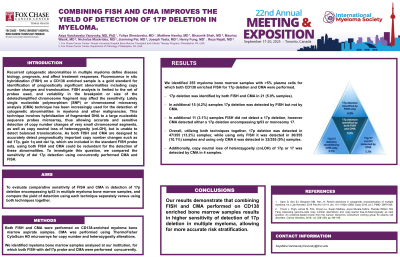
Recurrent cytogenetic abnormalities in multiple myeloma define disease biology, prognosis, and affect treatment responses. Fluorescence in situ hybridization (FISH) on a CD138 enriched sample is a gold standard for identification of prognostically significant abnormalities including copy number changes and translocation. FISH analysis is limited to the set of probes used, and variability in the breakpoint or size of the deleted/amplified chromosome fragment may affect the sensitivity. Lately single nucleotide polymorphism (SNP) or chromosomal microarray analysis (CMA) technique has been increasingly used for the detection of cytogenetic abnormalities in myeloma and other malignancies. This technique involves hybridization of fragmented DNA to a large nucleotide sequence probes microarray, thus allowing accurate and sensitive detection of copy number changes of very small chromosomal segments, as well as copy neutral loss of heterozygosity (cnLOH), but is unable to detect balanced translocations. As both FISH and CMA are designed to accurately detect prognostically important copy number changes such as del 17p, gain 1q and del 1p, which are included in the standard FISH probe sets, using both FISH and CMA could be redundant for the detection of these abnormalities. To investigate this question, we compared the sensitivity of del 17p detection using concurrently performed CMA and FISH.
Methods:
Both FISH and CMA were performed on CD138-enriched myeloma samples. CMA was performed using ThermoFisher CytoScan HD microarrays for copy number and heterozygosity alterations.
We identified myeloma bone marrow samples analyzed at our institution, for which both FISH with del17p probe and CMA were performed concurrently.
Results:
We identified 355 myeloma bone marrow samples with >5% plasma cells for which both CD138 enriched FISH for 17p deletion and CMA were performed.
17p deletion was identified by both FISH and CMA in 21 (5.9% samples). In additional 15 (4.2%) samples 17p deletion was detected by FISH but not CMA. In additional 11 (3.1%) samples FISH did not detect a 17p deletion, however CMA detected either a 17p deletion encompassing tp53 or monosomy 17. Overall, utilizing both techniques together, 17p deletion was detected in 47/355 (13.2%) samples; while using only FISH it was detected in 36/355 (10.1%) samples and using only CMA it was detected in 32/355 (9%) samples. Additionally, copy neutral loss of heterozygosity (cnLOH) of 17p or 17 was detected by CMA in 4 samples.
Conclusions: Our results demonstrate that combining FISH and CMA performed on CD138 enriched bone marrow samples results in higher sensitivity of detection of 17p deletion in multiple myeloma, allowing for more accurate risk stratification.