
Treatment of Relapsed/Refractory Myeloma (excluding T-cell redirection therapy)
Category: Treatment of Relapsed/Refractory Myeloma (excluding T-cell redirection therapy)
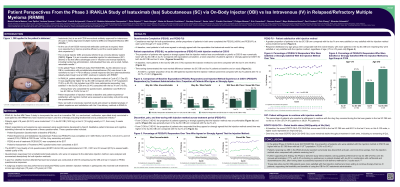
Patient perspectives from the Phase 3 IRAKLIA study of isatuximab (Isa) subcutaneous (SC) via on-body injector (OBI) vs Isa intravenous (IV) in relapsed/refractory multiple myeloma (RRMM)

María-Victoria Mateos, MD, PhD
Consultant Physician, Associate Professor of Medicine
Hematology Department, University Hospital of Salamanca/IBSAL/Cancer Research Center-IBMCC (USAL-CSIC), Salamanca, Spain
Noninferiority of Isa OBI vs Isa IV was established for efficacy (overall response rate) and pharmacokinetics (steady state trough level) in RRMM patients (pts) in the global Phase 3 IRAKLIA trial (NCT05405166). Meeting pt expectations and preferences about treatment may reduce their burden and improve adherence. The proportion of pts in IRAKLIA who were satisfied with the injection method at Cycle (C) 5 Day (D) 15 (key secondary endpoint) was higher with Isa OBI than Isa IV (ITT population: 70.0% vs 53.4%). This present analysis details pt satisfaction with the two Isa delivery methods in IRAKLIA.
Methods:
531 pts aged ≥18 years with ≥1 prior line of therapy were randomized 1:1 to Isa OBI (1400 mg) or Isa IV (10 mg/kg) weekly in C1, then every 2 weeks with pomalidomide-dexamethasone. The patient expectations questionnaire (PEQ) was issued at baseline (BL), the patient experience and satisfaction questionnaire (PESQ) was issued at C1 (D8/15/22), C2 (D1/15), C3+4 (D1), and C5 onwards (D15), and the EORTC Core Quality of Life questionnaire (EORTC-QLQ-C30) was issued at C1D1, C2D1 and C3 onwards (D15).
Results:
Similar proportions of pts in both arms completed the PEQ at BL (≥82%) and PESQ on study (≥72.2%). The proportion of pts in both Isa arms agreeing/strongly agreeing on study that the injection method was uncomfortable, painful, or resulted in side effects was lower than what was expected at BL (Table). Time saving compared with other methods was the most marked difference between Isa OBI and IV pts at BL and on study (Table). A greater proportion of Isa OBI than IV pts were also satisfied with the injection method throughout the study. At each timepoint, a higher proportion of Isa OBI than IV pts agreed/strongly agreed that the medication was worth taking, were satisfied/very satisfied, and would definitely/probably recommend the medication received via that injection method to another patient. The Isa arms did not differ at BL or during treatment in global health status on the EORTC-QLQ-C30.
Conclusions:
During IRAKLIA, pts receiving Isa OBI reported experiencing numerically less discomfort, pain, and side effects, and more time savings, from the injection method than Isa IV. These data suggest Isa OBI pts were more satisfied with and more likely to recommend their therapy than Isa IV pts and support the feasibility of using the OBI for Isa SC administration.
Table. Descriptive analyses among PEQ/PESQ responders
| % | Agree/ strongly agree | BL OBI | BL IV | C5D15 OBI | C5D15 IV | On study* OBI | On study* IV |
| Injection method | Discomfort | 35.8 | 48.6 | 13.8 | 16.3 | 0-13.8 | 8.3-22.5 |
| Painful | 41.2 | 39.3 | 6.9 | 10.4 | 0-7.0 | 6.3-15.2 | |
| Side effects | 50.0 | 51.9 | 12.2 | 9.9 | 0-15.0 | 4.2-19.0 | |
| Time saving | 73.0 | 40.8 | 83.1 | 32.7 | 74.5-91.7 | 26.3-52.2 | |
| Satisfied | - | - | 96.8 | 70.8 | 88.0-100 | 64.4-78.3 | |
| Medication | Side effects | 52.2 | 60.2 | 13.8 | 15.8 | 0-22.3 | 6.3-29.4 |
| Worth taking | 74.8 | 73.6 | 93.1 | 74.8 | 76.4-100 | 66.4-84.9 | |
| Satisfied | - | - | 92.1 | 82.2 | 78.6-96.8 | 68.8-87.7 | |
| Recommend | - | - | 93.7 | 81.7 | 83.7-100 | 63.6-81.7 |
*For visits where n≥20.
Funding: Sanofi.