
Cellular and T cell engager Immunotherapy
Category: Cellular and T cell engager Immunotherapy
Reshaping Treatments: Insights from the BiTAL Study on Talquetamab in Relapsed Refractory Multiple Myeloma.
.jpg "Paula Rodríguez-Otero, MD, PhD (she/her/hers) photo")
Paula Rodríguez-Otero, MD, PhD (she/her/hers)
Medical Coordinator
Cancer Center Clínica Universidad de Navarra, Centro de Investigación Médica Aplicada (CIMA), Instituto de Investigación Sanitaria de Navarra (IdiSNA)
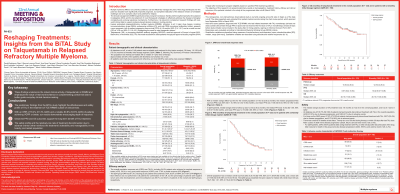
This ongoing, retrospective, observational study encompasses pts data collected from 64 Spanish centers covering a chart review period from September 2024 to March 2025. The study included adult pts with TCE RRMM who initiated TAL monotherapy within the PAA programs, between November 22-24. Key eligibility criteria mandated pts to have received their initial dose of TAL at least 30 days before study commencement and to have provided informed consent. Pts demographics, treatment history, and clinical outcomes were systematically analyzed.
Results: A total of 148 pts met the criteria for analysis at the data cut-off. The median age of the participants was 66.5 years, with 71 (48.0%) females. Median number of prior lines to TAL was 4.0 (1-9). All pts were triple-class exposed, and 70.9% were triple refractory. Mean time to follow-up was 11.1 months, and the mean duration of TAL was 8.2 months. The ORR was 78.4%, with 24.8% pts achieving complete responses or better (>CR), and 60.8% with a very good partial response or better (>VGPR). According to the biweekly initial dosage regimen, the ORR was 81.3%, 25.2% of pts achieved >CR, and 63.6% >VGPR. Pts experienced a mean PFS and overall survival (OS) of 11.56 and 17.59 months, respectively. In the biweekly initial dosage regimen group, pts mean PFS and OS were 12.15 and 18.21 months, respectively. Adverse events (AE) characteristic of GPRC5D T-cell redirection therapy were skin-related events (71.6%), CRS (59.5%), infection (52.0%), dysgeusia (46.6%), nail-related events (41.2%), weight loss (10.1%), and ICANS (8.1%). Concerning pts who permanently discontinued treatment (N=84), 50.0% discontinued treatment primarily due to disease progression or lack of response, and only a minimal percentage (6.0%) discontinued as a result of AE.
Conclusions: The preliminary findings from the BiTAL study highlight the effectiveness and safety profile of TAL in the treatment of this complex TCE RRMM pts, demonstrating encouraging depth of response. Observed PFS and OS outcomes support long-term benefit, while the safety profile and low discontinuation rate due to AEs reinforces the treatment’s tolerability in this heavily pre-treated population.