
Cellular and T cell engager Immunotherapy
Category: Cellular and T cell engager Immunotherapy
Acquired FCRL5 Mutation Leading to Cevostamab Resistance in Multiple Myeloma

Cecilia Bonolo de Campos, PhD
Scientific Associate
Princess Margaret Cancer Centre
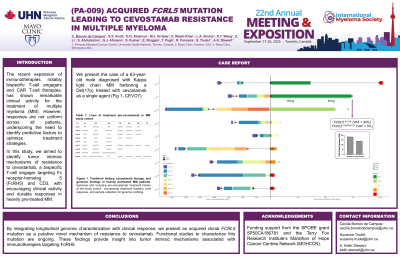
We present the case of a 63 year old male diagnosed with Kappa light chain MM harboring a Del(17p) treated with cevostamab as a single agent in the fifth line of therapy. Previous treatment lines included dexamethasone, cyclophosphamide, proteasome inhibitors (bortezomib and ixazomib), and IMiDs (lenalidomide and pomalidomide). Bone marrow aspirates were collected at baseline and progression for DNA and RNA extraction from sorted CD138+ cells. Tumor whole genome and transcriptome sequencing were performed at baseline, and whole exome sequencing and transcriptome sequencing was performed at cevostamab progression.
The patient was initially treated with 60 mg of cevostamab for one year and then escalated to a higher dose cohort (90 mg) in the second year, achieving stringent complete response as the best response. At progression, whole exome sequencing detected a clonal FCRL5E115A missense mutation (allelic frequency = 56%) and a subclonal FCRL5G455Efs*19 frameshift deletion mutation (allelic frequency = 5%). Importantly, both FCRL5 mutations were absent at baseline. FCRL5 gene expression was marginally downregulated at progression compared to baseline (log2FC = -0.4).
Following cevostamab progression, the patient was treated with daratumumab and a bispecific T-cell engager targeting B-cell maturation antigen (BCMA) and CD3. The patient achieved complete response and has been in remission for four years.
Conclusions: By integrating longitudinal genomic characterization with clinical response, we present an acquired clonal FCRL5 mutation as a putative novel mechanism of resistance to cevostamab. Functional studies to characterize this mutation are ongoing. These findings provide insight into tumor intrinsic mechanisms associated with immunotherapies targeting FcRH5.