
Treatment of Relapsed/Refractory Myeloma (excluding T-cell redirection therapy)
Category: Treatment of Relapsed/Refractory Myeloma (excluding T-cell redirection therapy)
Understanding Specific Treatment Sequences in Multiple Myeloma Dependent on the Treatment Received in Second Line: Survey Data from 141 International Clinicians

Joshua Richter, MD
Associate Professor
Icahn School of Medicine at Mount Sinai
This cross-sectional survey (January to March 2025) included data from 141 hematologists, oncologists, and onco-hematologists across 5 countries: United States (US), United Kingdom (UK), Canada (CA), France (FR), and the Netherlands (NL). Physicians were recruited if they met the following criteria: 1) practiced medicine for 3-30 years 2) ≥60% of time spent in direct patient care 3) responsible for treating MM patients and 4) ≥10 MM patients treated per year.
Respondents estimated the percentage of patients they prescribed each treatment regimen in 1L through 4L. Treatment regimens in 3L and 4L were reported separately based on treatments used in 2L and 3L, respectively.
Results:
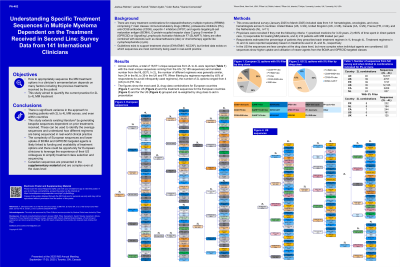
N=141 clinicians completed the survey (US: 49, UK: 28, CA: 29, FR: 24, NL: 11). Across countries, a total of 18,671 unique sequences from 2L to 4L were reported with the most unique sequences coming from the US (12,185 sequences) and least from the NL (837). The remaining number of sequences were as follows: CA=2269, UK=4757, and FR=1737.
In 2L, the number of different regimens was generally similar, from 24 in the NL to 39 in the UK and FR. When filtering by regimens reported by ≥5% of respondents (to avoid infrequently used regimens), the number of 2L options ranged from 4 (UK) to 8 (FR / NL).
Using the European countries as an example, the most common 2L regimen was CD38+PI+dexamethasone (dex; 35%). These patients’ 3L options included: PI+IMid+dex (30%), CD38+IMiD+dex (14%), PI +Dex (12%), BCMA bispecific antibodies (BsAb; 15%), BCMA CAR T (9%), IMiD+cyclophosphamide+dex (8%), IMid (6%), or SLAMF7+IMiD+dex (6%). For patients on the most common 3L option (PI+IMiD+dex) in this sequence, their 4L options were a BCMA BsAb (37%), BCMA CAR T (10%), PI+dex (8%), CD38+IMiD+dex (15%), CD38+PI+dex (10%), IMiD+dex (9%), conventional chemotherapy (8%), and SLAMF7+dex (4%).
Conclusions:
There is significant variance in the approach to treating patients with 2L-4L MM across, and even within countries. This study extends existing literature by generating bespoke sequences dependent on prior treatments received. These can be used to identify the average sequence and understand how different regimens are being sequenced in real-world clinical practice.