
Myeloma Novel Drug Targets and agents
Category: Myeloma Novel Drug Targets and agents
HUWE1 inhibition impacts MYC expression leading to increased DNA damage in combination with Bortezomib
.jpg "Beth M. McCrea, BSc (she/her/hers) photo")
Beth M. McCrea, BSc (she/her/hers)
PhD Student
Queen's University Belfast
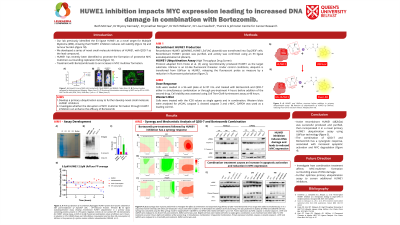
Despite significant therapeutic advances, the majority of multiple myeloma (MM) patients develop relapsed/refractory disease, emphasizing the need for novel approaches to improve the efficacy of current treatments. Previous work from our lab highlighted the potential of the E3 ligase HUWE1 as a therapeutic target and developed a series of novel HUWE1 inhibitors, including a lead compound QDD-7. HUWE1 is implicated in many key cellular processes and was recently identified to promote the formation of c-MYC multimers surrounding stalled replication forks as a protective mechanism against DNA damage. Treatment with Bortezomib leads to an increase in c-MYC multimer formation. In this study, we investigate the combination of HUWE1 inhibition with Bortezomib and develop a high throughput assay to screen for inhibitors of HUWE1.
Methods:
MM cell lines (JJN3, OPM2, KMS12, MOLP8) were treated with Bortezomib and QDD-7 simultaneously or sequentially through 4-hour pre-treatment. Cell viability was measured using Cell Titre-Glo® luminescent assay and synergy was calculated using the Bliss Synergy Model (SynergyFinder+). Cells treated with IC50 values of Bortezomib or QDD-7 as single agents and in combination were harvested for protein 2, 4, 6 and 24h post treatment and analysed for markers of DNA damage and apoptosis through Western Blotting. Auto-ubiquitination of HUWE1 was measured using either UbiQaptureTM combined with Western blotting or with UbFluor, an E2-ubiquitin fluorescent thioester, to measure fluorescence polarisation (FP) in a high throughput assay.
Results:
The novel inhibitor QDD-7 effectively inhibited HUWE1 activity across MM cell lines, as measured using UbiQapture, and this was associated with induction of γH2AX, indicating DNA damage and reduced c-MYC protein expression. Synergy analysis on combinations of Bortezomib and QDD-7 was determined using bliss synergy scores, where >10 indicates synergy, between -10 and 10 shows an additive effect and < -10 is antagonistic. Bortezomib pre-treatment was identified to be the most effective combination with bliss synergy scores ≥ 16.82, while simultaneous combinations were additive (synergy score ≥1.58). Western blot analysis demonstrated that combination treatments increased γH2AX and cleaved caspase-3 expression compared to single agents, indicating an increase in DNA damage and apoptosis, respectively. A novel primary ubiquitination assay incorporating full length HUWE1 was developed and optimised for high-throughput screening of prospective HUWE1 inhibitors.
Conclusions:
Dual inhibition of HUWE1 and proteasome activity demonstrates a synergistic response, associated with an increase in DNA damage and apoptotic activation, suggesting that disruption of c-MYC multimer formation through HUWE1 inhibition can enhance the efficacy of Bortezomib. Future work will use the novel primary HUWE1 activity assay to screen for clinically relevant inhibitors of HUWE1.