
Myeloma Novel Drug Targets and agents
Category: Myeloma Novel Drug Targets and agents
Mezigdomide (MEZI) in novel targeted combinations for relapsed/refractory multiple myeloma (RRMM): updated results from the phase 1/2 CA057-003 trial

Luciano J. Costa, MD
Professor, Medicine
University of Alabama Birmingham Hospital
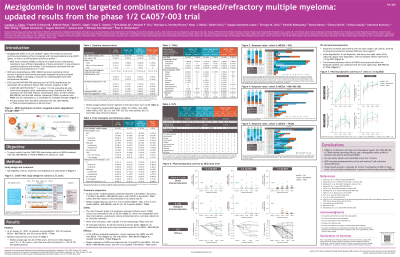
Eligible patients (pts) had RRMM with progressive disease (PD) during/after the last treatment (Tx), ECOG PS score ≤1, and were intolerant to/ineligible for all available established Tx. Oral MEZI (0.3/0.6/1.0mg) was given daily (QD) on days (D)1–21 of each 28-D cycle with weekly DEX 40mg (20mg if ≥75 y) plus oral TAZ 800mg twice daily on D1–28, oral BMS-986158 2/3mg QD 5D-on-2D-off D1–14, or oral TRAM 1.5/2mg QD on D1–21. Primary aims were to define recommended phase 2 dose, dosing schedule, and safety; secondary aims included efficacy and pharmacokinetics.
Results:
By Oct. 4, 2024, 16 pts received MEZId+TAZ, 20 MEZId+BMS-986158, and 20 MEZId+TRAM. Overall, median (range) age was 63 (37–83) y, time since initial diagnosis was 7.9 (1.2–18.4) y, and 21 (37.5%) pts had extramedullary plasmacytomas. Median (range) no. of prior Tx was 5 (2–20), including IMiD® agents, proteasome inhibitors, and anti-CD38 mAbs (100% each), ASCT (82.1%), and T-cell–redirecting therapy (57.1%); 82.1% had triple-class refractory disease.
At data cutoff, 6 (37.5%) pts continued Tx with MEZId+TAZ, 6 (30.0%) with MEZId+BMS-986158, and 12 (60.0%) with MEZId+TRAM. The main reason for discontinuation was PD. Median (range) follow-up was 5.7 (1.3–14.3) mo (MEZId+TAZ), 4.2 (1.0–12.1) mo (MEZId+BMS-986158), and 5.1 (1.9–15.7) mo (MEZId+TRAM).
Neutropenia was the most common grade (Gr) 3/4 Tx-emergent adverse event (TEAE) (62.5%–85.0%); Gr 3/4 nonhematologic TEAEs were low; 8 pts had dose-limiting toxicities (1 with 1.0mg MEZId+TAZ; 1 with 0.3mg, and 4 with 1.0mg MEZId+BMS-986158; 2 with 1.0mg MEZId+TRAM).
In the efficacy-evaluable population, ORR was 50.0% with MEZId+TAZ, 35.0% with MEZId+BMS-986158, and 75.0% with MEZId+TRAM. Deeper responses (≥VGPR) were observed with 1.0mg MEZI in the MEZId+TAZ (50.0%) and MEZId+BMS-986158 (20.0%) cohorts; and with ≥0.6mg MEZI in the MEZId+TRAM cohort (53.0%); 84.6% pts had ongoing responses with 1.0mg MEZI.
Exposures increased dose-linearly over dose ranges, and across cohorts, showing no drug–drug interaction between MEZI and novel agents. MEZI was pharmacodynamically active, inducing Ikaros/Aiolos degradation and B-cell reduction in all regimens at all dose levels; MEZI 1.0mg had the greatest effect. T-cell activation and proliferation were observed, independent of study-drug combination.
Conclusions: MEZId plus TAZ, BMS-986158, or TRAM showed promising efficacy and safety in RRMM, supporting further exploration of these novel all-oral combinations. ©American Society of Hematology (2024). Reused with permission.