
MRD and Biomarkers
Category: MRD and Biomarkers
Verification and optimization of VTE risk stratification system for multiple myeloma in China based on review cohort
.jpg "Yuexiao Liu, MA photo")
Yuexiao Liu, MA
Doctor
Fuxing Hospital, Capital Medical University
Venous thromboembolism (VTE) is a common complications in multiple myeloma (MM), linked to poor prognosis. The International Myeloma Working Group (IMWG) recommends stratified prevention for MM patients via VTE risk assessment models. Validating and optimizing a VTE risk assessment model for MM is crucial for hematologists to better identify the VTE risk in MM patients.
Methods:
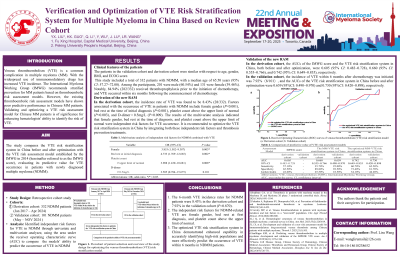
This study is retrospective. ①Derivation cohort: We selected 332 NDMM patients admitted to Fu Xing Hospital, Capital Medical University from January 2017 to April 2024. Patients were categorized into VTE and non-VTE groups based on the occurrence of VTE within six months following the initiation of chemotherapy. We identified independent risk factors for VTE in NDMM through univariate and multivariate analyses. Further optimize the VTE risk stratification system in China based on the identified independent risk factors. ②Validation cohort: 101 NDMM patients who visited the hospital from May 2024 to November 2024. The predictive efficacy of the VTE risk stratification system in China, before and after optimization, will be compared for their ability to predict the occurrence of VTE in NDMM using the area under the receiver operating characteristic curve (AUC).
Results:
The patients in the validation cohort and derivation cohort were similar with respect to age, gender, BMI, and ECOG score. This validation cohort included 332 NDMM, median age of 65.50 years (95% CI: 57.27~72.00). There were 201 male (60.54%) and 131 female (39.46%). Notably, 84.94% (282/332) received thromboprophylaxis before the initiation of chemotherapy, and VTE occurred within six months was 8.43% (28/332). Factors associated with the occurrence of VTE in patients with NDMM include female (P< 0.001), bed rest at diagnosis (P< 0.001), platelet count above the upper limit of normal (ULN) (P=0.003), and D-dimer>0.5mg/L (P=0.009). The results of the multivariate analysis indicated that female gender, bed rest at diagnosis, and platelet count above the ULN are independent risk factors for VTE. It is recommended to optimize the VTE risk stratification system in China with these independent risk factors and thrombosis prevention treatments. The AUCs of the IMWG score and the VTE risk stratification system in China, both before and after optimization, were 0.605 (95% CI: 0.483~0.728), 0.660 (95% CI: 0.555~0.766), and 0.742 (95% CI: 0.649~0.835), respectively. The validation cohort includes 101NDMM, the incidence of VTE within 6 months was 7.92%(8/101), and the AUCs of the VTE risk stratification system in China before and after optimization were 0.659 (95%CI: 0.490~0.970) and 0.730 (95%CI: 0.420~0.898), respectively.
Conclusions:
MM-related VTE predominantly occurred within the first 6 months following chemotherapy initiation. Lower extremity deep vein thrombosis constituted the most common VTE manifestation. The optimized VTE risk stratification system in China demonstrated enhanced capability in accurately identifying high-risk populations.