
MRD and Biomarkers
Category: MRD and Biomarkers
Quantitative CD38 Expression and Clinical Response to Anti-CD38 Therapy in Multiple Myeloma: A Retrospective Cohort Analysis

Jianlin Hu, Master of Medicine
MD Candidate
Department of Hematology, Tongji Hospital, Tongji Medical College, Huazhong University of Science and Technology
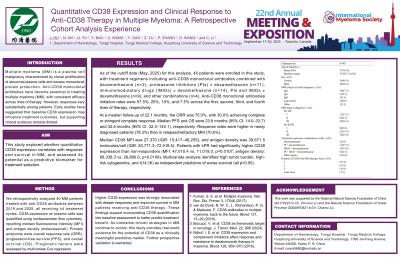
Anti-CD38 monoclonal antibodies have become essential in treating multiple myeloma (MM), with consistent efficacy across lines of therapy. However, responses vary substantially among patients. Early studies have suggested that baseline CD38 expression may influence treatment outcomes, but supporting clinical evidence remains limited. This study explored whether quantitative CD38 expression correlates with response and survival in MM, and assessed its potential as a predictive biomarker for treatment selection.
Methods:
We retrospectively analyzed 40 MM patients treated with anti-CD38 antibodies (daratumumab or isatuximab) between 2019 and 2025, all receiving ≥4 treatment cycles. CD38 expression on plasma cells was quantified using multiparameter flow cytometry, reporting median fluorescence intensity (MFI) and antigen density (molecules/cell). Treatment regimens included combinations with dexamethasone alone (n=2), proteasome inhibitors (PIs, n=11), immunomodulatory drugs (IMiDs, n=14), both PIs and IMiDs (n=9), or other agents (n=4). Patients were treated in first (57.5%), second (25.0%), third (10.0%), or later lines (7.5%). Primary endpoints were overall response rate (ORR), progression-free survival (PFS), and overall survival (OS). Prognostic factors were assessed by multivariate Cox regression.
Results:
At a median follow-up of 22.1 months (data cutoff: May 2025), the ORR was 75.0%, with 30.0% achieving complete or stringent complete response. Median PFS and OS were 23.8 months (95% CI: 14.0–33.7) and 32.6 months (95% CI: 32.3–140.1), respectively. Response rates were higher in newly diagnosed patients (78.3%) than in relapsed/refractory MM (70.6%).
Median CD38 MFI was 27,370 (IQR: 15,417–46,255), and antigen density was 39,671.5 molecules/cell (IQR: 20,771.3–72,516.5). Patients with ≥PR had significantly higher CD38 expression than non-responders (MFI: 47,010.4 vs. 11,019.0, p=0.0107; antigen density: 68,338.3 vs. 26,880.6, p=0.0109). Multivariate analysis identified high tumor burden, high-risk cytogenetics, and t(14;16) as independent predictors of worse survival (all p< 0.05).
Conclusions:
Higher CD38 expression was strongly associated with deeper responses and improved survival in MM patients receiving anti-CD38 therapy. These findings support incorporating CD38 quantification into baseline assessment to better predict treatment benefit. As biomarker-driven strategies in MM continue to evolve, this study provides real-world evidence for the potential of CD38 as a clinically meaningful predictive marker. Further prospective validation is warranted.