
Cellular and T cell engager Immunotherapy
Category: Cellular and T cell engager Immunotherapy
CAC-MM-001: Anti-BCMA CAR-T Therapy Followed by Autologous Stem Cell Transplantation and second CAR-T (CART-ASCT-CART2) in Newly Diagnosed Multiple Myeloma Patients with P53 gene abnormalities.
Yuntong Liu, liuyuntong@ihcam.ac.cn
Nanjing Road 288,Tianjin
Institute of Hematology & Blood Diseases Hospital, Chinese Academy of Medical Sciences & Peking Union Medical College
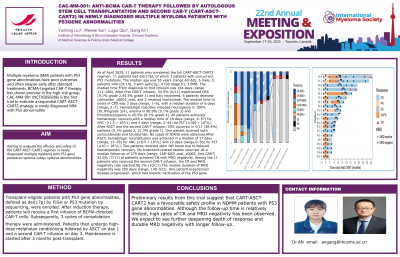
Multiple myeloma (MM) patients with P53 gene abnormalities have poor outcomes and often relapse early after standard treatments. BCMA-targeted CAR-T therapy has shown promise in the high-risk group. CAC-MM-001 (NCT05850286) is the first trial to evaluate a sequential CART-ASCT-CART2 strategy in newly diagnosed MM with P53 abnormalities.
Methods:
Transplant-eligible patients with P53 gene abnormalities, defined as del(17p) by FISH or P53 mutation by sequencing, were enrolled. After induction therapy, patients will receive a first infusion of BCMA-directed CAR-T cells. Subsequently, 3 cycles of consolidation therapy were administered. Patients then undergo high-dose melphalan conditioning followed by ASCT on day 1 and a second CAR-T infusion on day 3. Maintenance is started after 3 months post-transplant.
Results:
As of April 2025, 11 patients who completed the full CART-ASCT-CART2 regimen. 11 patients had del(17p), of which 3 patients with concurrent P53 mutations. The median age was 55 years (range 40-60), 6 male, 5 patients with t(4;14), 3 with gain(1q), 4 ISS stage III, 3 EMB.
The median time from diagnosis to first infusion was 164 days (range 111-280). After first CAR-T infusion, 54.5% (6/11) experienced CRS (9.1% grade 2, 45.5% grade 1) and fully recovered. 6 patients received corticosteroids, and 2 received tocilizumab. The median time to onset of CRS was 3 days (range, 1-6), with a median duration of 6 days (range, 2-7). Hematologic toxicities included neutropenia in 100% (81.8% grade 3/4), anemia in 90.9% (9.1% grade 3) and thrombocytopenia in 45.5% (9.1% grade 4). All patients achieved hematologic recovery, with a median time of 18 days (range, 4–57) for ANC (≥1.5×10⁹/L) and 4 days (range, 2–44) for PLT (≥100×10⁹/L). After ASCT and the second CAR-T infusion, CRS occurred in 4/11 (36.4%) patients (9.1% grade 2, 27.3% grade 1). One patient received both corticosteroids and tocilizumab. No cases of ICANS were observed. After ASCT, hematologic reconstitution was achieved in a median of 17 days (range, 13–28) for ANC (≥0.5×10⁹/L) and 12 days (range, 8–50) for PLT (≥20×10⁹/L). Two patients received stem cell boost due to delayed hematopoietic recovery. No treatment-related deaths occurred.
At a median follow-up of 279 days (range, 168–602) post-first CAR-T, 63.6% (7/11) of patients achieved CR with MRD negativity. Among the 11 patients who received the second CAR-T infusion, the CR and MRD negativity rate reached 90.1% (10/11). The median duration of MRD negativity was 255 days (range, 140–523). One patient experienced disease progression, which had biallelic inactivation of the P53 gene.
Conclusions:
Preliminary results from this trial suggest that CART-ASCT-CART2 has a favourable safety profile in NDMM patients with P53 gene abnormalities. Although the follow-up time is relatively limited, high rates of CR and MRD negativity has been observed. We expect to see further deepening depth of response and durable MRD negativity with longer follow-up.