
Treatment of Newly Diagnosed Myeloma (excluding t-cell redirection therapy)
Category: Treatment of Newly Diagnosed Myeloma (excluding t-cell redirection therapy)
HSPA9 contributes to tumor progression and ferroptosis resistance by enhancing USP14-driven xCT deubiquitination in multiple myeloma


Na Shen, PhD
doctor
Department of Hematology, Jiangsu Province Hospital, the First Affiliated Hospital of Nanjing Medical University
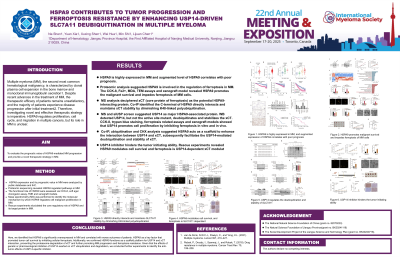
HSPA9 is highly expressed in MM and augmented level of HSPA9 correlates with poor prognosis. Proteomic analysis suggested HSPA9 is involved in the regulation of ferroptosis in MM. The CCK-8, Fe2+, MDA, TEM assays and xenograft model revealed HSPA9 promotes the malignant survival and impedes ferroptosis of MM cells. MS analysis deciphered xCT (core protein of ferroptosis) as the potential HSPA9-interacting protein. Co-IP identified the C-terminal of HSPA9 directly interacts and maintains xCT stability by diminishing K48-linked polyubiquitination. MS and siUSP screen suggested USP14 as major HSPA9-associated protein. WB detected USP14, but not the active site mutant, deubiquitinates and stabilizes the xCT. CCK-8, trypan blue staining, ferroptosis related assays and xenograft models showed that USP14 promotes cell proliferation by inhibiting ferroptosis in vitro and in vivo. Co-IP, ubiquitination and CHX analysis suggested HSPA9 acts as a scaffold to enhance the interaction between USP14 and xCT, subsequently facilitates the USP14-mediated deubiquitination and stability of xCT. USP14 inhibitor hinders the tumor initiating ability. Rescue experiments revealed HSPA9 modulates cell survival and ferroptosis is USP14-dependent xCT modulation.
Conclusions:
Here, we identified that HSPA9 is significantly overexpressed in MM and correlated with worse outcomes of patients. HSPA9 as a key factor that promoted tumor cell survival by inhibiting cellular ferroptosis. Additionally, we confirmed HSPA9 functions as a scaffold platform for USP14 and xCT interaction, preventing the proteasome-degradation of xCT and further promoting MM progression and ferroptosis resistance. Given that the effects of genetic or pharmacological inhibition of USP14 exerted on xCT ubiquitination and degradation, we conducted further experiments to identify the anti-tumor effects of USP14-specific inhibitor.