
Plasma Cell precursor and Other Disorders
Category: Plasma Cell precursor and Other Disorders
Mortality and Inpatient Hospitalization Rates Amongst Light-Chain Amyloidosis (AL) Patients During the Daratumumab Era: Results from an Analysis of US Medicare Fee-for-Service (FFS) Beneficiaries

Julia Catini, PharmD, MBA (she/her/hers)
Sr. Global Medical Director
Alexion, AstraZeneca Rare Disease
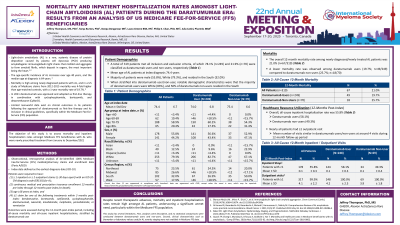
An observational, retrospective analysis of de-identified 100% Medicare Fee-for-Service (FFS) medical and pharmacy claims and enrollment data (Parts A/B/D) from January 1, 2020 to December 31, 2022 was performed. The index date was defined as the earliest diagnosis date (ICD-10 code) of AL within the identification window of January 1, 2021 to December 31, 2021. Patients were required to have: (1) ≥ 1 inpatient or ≥ 2 outpatient claims (≥ 30 days apart) with an ICD-10-CM diagnosis code (E85.81) for AL; (2) continuous medical and prescription insurance enrollment from 12-months pre-index through 12-months post-index (or death); (3) age ≥18 years at index, and (4) ≥1 claim for one of the following treatments within 3 months post-index: bendamustine, bortezomib, carfilzomib, cyclophosphamide, daratumumab, ixazomib, lenalidomide, melphalan, pomalidomide, or venetoclax. Patients with a prior claim for AL at baseline or any claim for stem cell transplant were excluded. Outcomes were assessed during the 12-month post-index period, including all-cause mortality and all-cause inpatient hospitalizations, stratified by daratumumab use (initiated within 3 months post-index-diagnosis).
Results:
A total of 319 patients met all inclusion and exclusion criteria, of which 78.1% (n=249) and 21.9% (n=70) were classified as daratumumab users and nonusers, respectively. A majority of patients were age 70+ (79.3%; n=253), male (55.8%; n=178), White (79.3%; n=253), and resided in the South (32.0%; n=102). The overall annual mortality rate among newly diagnosed/newly treated AL patients was 21.0% (n=67/319), with a lower rate observed among daratumumab users (19.7%; n=49/249) compared to daratumumab nonusers (25.7%; n=18/70). Differences were also observed when assessing all-cause inpatient hospitalization rates during the 12-month post-index period, with 57.8% (n=144/249) and 48.6% (n=34/70) seen among daratumumab users and nonusers, respectively.
Conclusions:
Despite recent therapeutic advances, mortality and inpatient hospitalization rates remain high amongst AL patients, underscoring a significant unmet need, particularly within the Medicare FFS population.