
Myeloma Genomics and Microenvironment and immune profiling
Category: Myeloma Genomics and Microenvironment and immune profiling
Targeting PIM-2 and PARP1 Induces MICA Expression on Multiple Myeloma Cells to Activate NK Cells Through NKG2D Binding

Zhaoyun Liu, MD (he/him/his)
vice-professor
Tianjin medical university general hospital hematoloy department
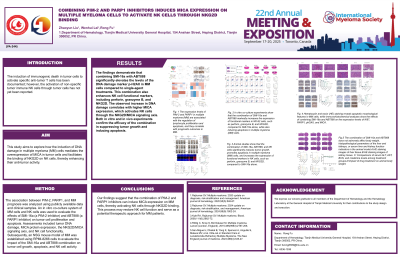
The ability to induce immunogenic death in tumor cells has been shown to activate specific anti-tumor T cells; however, the potential of non-specific natural killer (NK) cells to be activated through interaction with tumor cells remains under-researched. This study aims to investigate how inducing DNA damage in multiple myeloma (MM) cells leads to overexpression of MICA, facilitating the binding of NKG2D on NK cells and enhancing their anti-tumor activities.
Methods:
The relationship between PIM-2, PARP1, and prognostic outcomes in MM was analyzed using publicly available data alongside clinical samples. An in vitro co-culture system composed of MM cells and NK cells was employed to assess the effects of SMI-16a (PIM-2 inhibitor) and ABT888 (PARP1 inhibitor) on tumor proliferation and apoptosis. Key metrics included DNA damage assessment, evaluation of MICA protein expression, the NKG2D/MICA signaling axis, and NK cell functionality. Subsequently, an NSG mouse model was established using RPMI-8266 cells to assess the combined effect of SMI-16a and ABT888 on tumor growth, apoptosis, and NK cell activity.
Results:
The combination of SMI-16a and ABT888 resulted in a marked increase in DNA damage, indicated by elevated levels of the marker pH2AX in MM cells, relative to single-agent treatments. This combination also significantly boosted functional markers in NK cells, including perforin, granzyme B, and NKG2D. The increase in DNA damage was correlated with heightened MICA expression, which activated NK cells via the NKG2D/MICA signaling pathway. Both in vitro and in vivo studies validated the efficacy of this combination in inhibiting tumor growth and promoting apoptosis.
Conclusions:
Our findings suggest that the concurrent application of PIM-2 and PARP1 inhibitors can significantly induce MICA expression on MM cells, thereby enhancing NK cell activation through NKG2D binding. This novel mechanism may restore NK cell function and represents a promising therapeutic strategy for multiple myeloma patients. Further investigations are warranted to elucidate the detailed mechanisms underpinning how SMI-16a and ABT888 induce DNA damage and subsequently enhance MICA expression in MM cells.