
Myeloma Genomics and Microenvironment and immune profiling
Category: Myeloma Genomics and Microenvironment and immune profiling
Referral of Select Multiple Myeloma Patients for Genetic Evaluation Leads to 5-Fold Increase in Pathogenic Germline Variant Detection

Maria Victoria del Rosal, MD (she/her/hers)
Research Associate
Department of Medicine, Hematology and Medical Oncology, Tisch Cancer Institute, Icahn School of Medicine at Mount Sinai, New York, NY
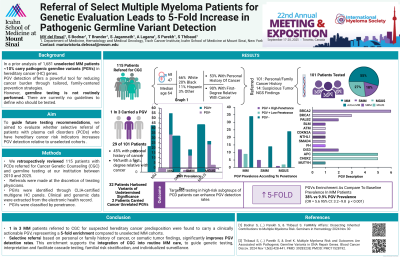
We retrospectively reviewed patients with PCDs referred for genetic counseling & germline testing at our institution between 2010 & 2025. Referrals were made at the discretion of treating physicians, based on clinical suspicion due to personal or family history of cancer and/or the presence of mutations in tumor NGS suggestive of germline origin. PGVs were identified through CLIA-certified multigene HC panels. Clinical & genomic data were extracted from the electronic health record. The primary outcome was PGV detection rate. 1 in 3 MM patients referred for suspected cancer predisposition carried a clinically actionable PGV, representing a fivefold enrichment over unselected MM cases. These findings highlight the feasibility & clinical utility of targeted germline screening in MM. A prospective study is underway to inform future testing guidelines.
Results: 115 PCD patients had a genetic evaluation by a certified genetic counselor. 101 were referred based on personal/family cancer history & 14 due to suspicious tumor NGS findings. Median age at referral was 64 (range 22–88) & 41% were male. 66% were White, 20% Black, 11% Hispanic & 3% Other. 61 patients (53%) had a personal history of other cancers & 104 (90%) had a first- or second-degree relative with cancer. 100 referred patients completed germline testing (87%), including 55 with MM, 18 smoldering MM (SMM) & 27 MGUS. 29 tested patients (29%) carried PGVs associated with HC: 20 MM (36% of all MM cases), 5 SMM (28% of all SMM cases) & 3 MGUS (11% of all MGUS cases). Compared to our previously published unselected MM cohort with a 9.9% PGV prevalence, the 36% detection rate in this selected MM subgroup represents a highly significant enrichment (OR 5.2, 95% CI 2.9–9.2, p=2.8×10⁻⁷). 18 of 29 PGVs were in high-penetrance HC genes, including BRCA2 (6), BRCA1 (3), PALB2 (2) & 7 others. The remaining 11 PGVs were low-penetrance founder variants in APC (5), CHEK2 (5) & MUTYH (1). 2 additional MM patients, not included in above calculations, were incidentally found to carry clinically actionable PGVs unrelated to cancer risk (long QT syndrome & hypertrophic cardiomyopathy). 13 PGV carriers (45%) had a personal history of cancer, most commonly colon (4), breast (3) & thyroid (3). 28 PGV carriers had a first-degree relative with cancer (97%), most frequently breast (13), gynecologic (9) & pancreatic (7).
Conclusions: